 look news india

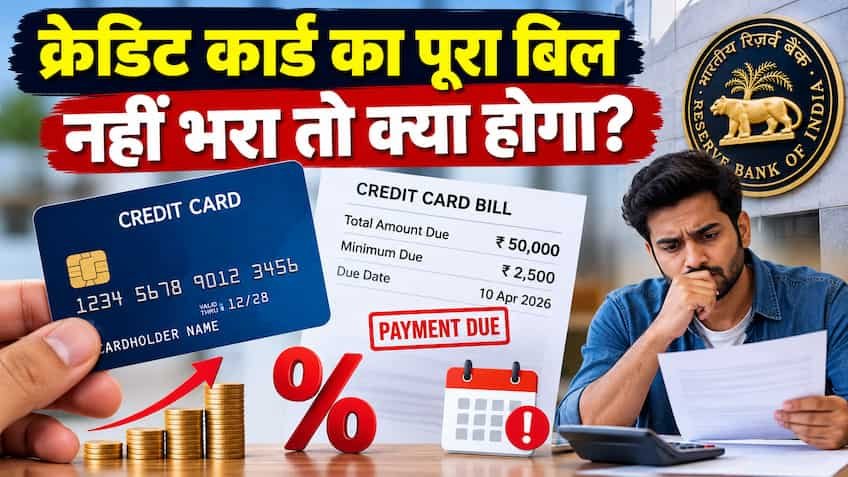
When the statement comes at the end of the credit card billing cycle, it contains two main figures – ‘Total Amount Due’ and ‘Minimum Amount Due’ (MAD). Often due to cash crunch, cardholders pay only the minimum due (usually 5% of the total bill) thinking that they are done and there will be no additional charges. But from the financial point of view this is the biggest confusing maze.
As per the Master Direction and banking rules of Reserve Bank of India (RBI), paying minimum due only gives you immediate relief from ‘Late Payment Penalty’, but the huge interest and additional charges hidden behind it empty your pocket.
-
Immediate end of interest-free period:
The 45 to 50 days interest-free period offered on credit cards is applicable only as long as you pay 100% of the total bill every month. Your interest-free period ends the moment you make the partial payment (Partial Payment or Minimum Due).
-
Calculation of interest from the date of transaction (Backdated Daily Interest):
Interest on outstanding amount is charged not from due date, but Counted from the day you made the purchase by swiping the card.
-
Interest charged on new expenses from day one:
Every new transaction made on the card (even if it is a Rs 100 grocery bill) starts attracting huge interest from the very first second until your entire old outstanding becomes zero.
-
Impact on Credit Utilization Ratio (CUR) and CIBIL Score:
Constant balance carrying keeps your credit utilization above the safe limit of 30%, which can bring down your CIBIL score with the credit bureaus (CIBIL/Experian).
On unpaid balance of Indian Bank Credit Card 3% to 3.50% per month i.e 36% to 42% per annum (APR) Charges compound interest up to Rs. Additionally, the government’s share on the total interest and finance charges charged by the bank 18% GST Connects separately.
The formula for calculating daily interest is as follows:
$$\text{Interest} = \frac{\text{Outstanding Amount} \times \text{Monthly Interest Rate} \times 12 \times \text{Number of Days}}{365 \times 100}$$
Understand with practical example:
Suppose you have dated 1st ₹50,000 Made a purchase. Your bill becomes ₹50,000 and minimum due comes out to be ₹2,500 (5%). You paid only ₹2,500 on the due date, leaving an outstanding of ₹47,500.
| Description | upon payment of full bill | Only on payment of minimum due (₹2,500) |
| late payment fee | Zero | Nil (no penalty) |
| Applicable Interest Rate (APR) | 0% | 42% per annum (3.5% per month) |
| monthly interest earned | ₹0 | ~₹1,660 to ₹1,900 (from transaction date) |
| 18% GST (on interest) | ₹0 | ~₹300 to ₹340 |
| Total amount payable next month | ₹0 | ~₹49,500 (That is, even after paying ₹ 2,500, the loan remains the same) |
If you keep paying only 5% minimum due on the outstanding balance of ₹50,000, it may take you 6 to 8 years to clear the entire loan and you will end up paying twice the principal amount just in interest and taxes.
Under the RBI’s ‘Credit Cards and Debit Cards – Issuance and Operating Instructions’ (Master Direction), several protective rules have been laid down for cardholders:
-
Interest on Net Dues Only: Earlier many banks used to add interest on the entire original bill. RBI has directed that interest can be charged only on the actual unpaid balance (Net Outstanding) remaining after payment.
-
Grace period of 3 days (3-Day Buffer Rule): Even after missing the due date, banks cannot immediately declare the account as ‘default’ or ‘past due’. It is mandatory to give a grace period of at least 3 days after the due date, within which payment does not attract late fees and CIBIL reporting.
-
Transparent Billing and Alerts: Banks are required to clearly display a warning in the credit card statement as to how many months or years it will take to repay the loan by paying only the minimum due and how much total interest will be payable.
-
Withholding on panel interest: RBI has banned compounding of unpaid dues by adding penal interest to the basic interest rate.
-
Choose Smart EMI (EMI Conversion): If you don’t have the cash to pay the full amount of ₹50,000, instead of paying 42% interest by paying the minimum due, convert it into a 6 to 12 month EMI immediately after billing. The interest on EMIs ranges from 14% to 18%, which is less than half of the 42% interest on credit cards.
-
Personal Loan or Balance Transfer: If the debt is large, pay off the entire credit card bill immediately by availing a low interest personal loan (10.5%-13%) or a sub 0% interest balance transfer option from another bank.
-
Stop using the card immediately: Do not spend even a single new rupee from that card until the entire previous balance becomes zero, as zero-interest facility is not available on new spends.