 look news india

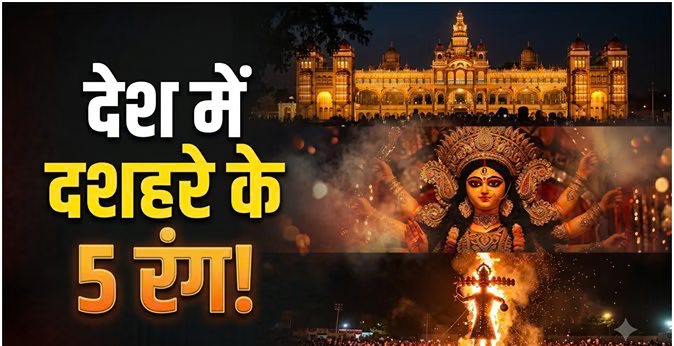
India is a country of diversity and cultural heritage, where many colors and unique styles of celebrating the same festival can be seen. Vijayadashami i.e. Dussehra is also one such holy festival, which is celebrated with great pomp throughout the country as the victory of religion over unrighteousness and truth over untruth. Generally, in most of the parts, on this day, effigies of Ravana, Kumbhkaran and Meghnad are burnt in memory of the killing of Ravana by Lord Shri Ram and huge Ramlilas are organised. However, there are some unique places on the cultural map of India where the form and traditions of Dussehra are completely different from the usual ways. At some places a grand festival of tribals is organized which lasts for 75 days, while at some places burning the effigy of Ravana is completely prohibited in the city of Lord Shiva. If you also want to deeply understand the unique beliefs and traditions of different corners of India on this Vijayadashami, then let us know about those 5 special places in the country where the style of celebrating Dussehra is most special and charming.
Kullu city situated in the beautiful valleys of Himachal Pradesh is famous all over the world for its historical and cultural ‘Kullu Dussehra’. While in the rest of the country the festival ends with Ravana Dahan on the day of Vijayadashami, in Kullu a huge seven-day long Dev Utsav begins from this day. The biggest specialty of this festival celebrated in Dhalpur ground of Kullu is that no effigy of Ravana, Kumbhkaran or Meghnad is burnt here. Instead, more than 200 local deities of Kullu Valley arrive in their decorated chariots to offer their obeisances to Lord Raghunath ji (Shri Ram). During this time, a grand procession is taken out, which is visited by lakhs of devotees from all over the country and abroad. On the seventh day, this unique festival is concluded with the symbolic ritual of Lanka Dahan by burning of grass on the banks of river Vyas and symbolic ritual of animal sacrifice.
If we talk about the longest and unique Dussehra, then the name of Jagdalpur and Bastar region of Chhattisgarh comes at the top. Bastar’s Dussehra is the longest running folk festival of its kind not only in India but in the entire world, which continues for about 75 days. The history of this festival is more than 600 years old, which was started by the kings of Kakatiya dynasty. The biggest feature of Bastar Dussehra is that this festival is not linked to the victory story of Lord Ram but is linked to the worship of the local presiding goddess ‘Maa Danteshwari’ and tribal culture. There is no tradition of burning the effigy of Ravana. Instead, huge wooden chariots are constructed which are pulled by hands by people of tribal communities. In this festival, we can see the glimpse of unwavering faith towards nature, soil and local life, which makes it very special and worth seeing.
Mysore city of Karnataka is famous globally for its royal and dignified ‘Mysuru Dasara’. The festival of Dussehra in Mysore is mainly celebrated to commemorate the victory of Goddess Chamundeshwari (Durga) over Mahishasura. On the day of Vijayadashami, Mysore Palace is decorated with lakhs of lamps and colorful lights in such a way that the entire palace shines like gold. The traditional ‘Jumbo Savari’ taken out on this day is the main attraction of this festival, in which the idol of Goddess Chamundeshwari sits in a pot made of 750 kg of gold on the back of a huge elephant. The tableau led by the Mysore royal family, cultural dances and the police force band spreads the royal splendor across the city. To see it, a large number of tourists come not only from South India but also from abroad.
The famous ‘Baijnath’ located in Kangra district of Himachal Pradesh is a place where the effigy of Ravana is not burnt on the day of Dussehra. Due to the very ancient Shiva temple located in Baijnath, this place has a deep religious connection with Ravana. According to mythological beliefs, Lankapati Ravana was a great devotee of Lord Shiva and he pleased Lord Shiva by doing rigorous penance at this place and obtained Shivalinga (Vaidyanath). Local people have an unwavering belief that Ravana was a great devotee of Lord Shiva and extremely knowledgeable, hence burning his effigy in this holy Shiva city is tantamount to disrespecting Lord Shiva. It is also believed that if any person tries to burn the effigy of Ravana in this city, he or his family may have to face great misfortune. Due to this fear and reverence, people here do not burn Ravana on Vijayadashami for centuries and worship Shiva peacefully.
Kota city, known as the education city of Rajasthan, has its own identity in the whole of North India for its grand ‘Kota Dussehra Fair’. The history of Dussehra in Kota is more than 125 years old, which was started by the rulers of the then princely state. Held at the Vijay Shree Theater grounds in Kota, this Dussehra fair lasts for several weeks, where artists from all over the country give their cultural performances. On the evening of Vijayadashami, huge 80 to 100 feet high effigies of Ravana, Kumbhkaran and Meghnad are burnt here, to see which lakhs of people gather. The grand fireworks during effigy burning and the echoes of traditional Rajasthani folk songs make this festival extremely exciting and energetic.
These diverse ways of celebrating Vijayadashami in different regions of India are living proof of how rich and tolerant our culture is. Be it the festival of meeting God in the mountains of Himachal, the confluence of nature and goddess worship in the forests of Chhattisgarh, the royal ride of Maa Chamundeshwari in the south, or the tradition of honoring Ravana due to devotion to Shiva; All these forms bind us together in a single thread. This festival is not limited to just entertainment or fairs, rather it gives the message that though the paths and methods may be different, ultimately the aim of every tradition is to establish goodness, truth and harmony by eradicating evil, ego and ignorance. On this Vijayadashami, you too should enjoy these unique traditions of India and resolve to follow the path of goodness in life.