 look news india

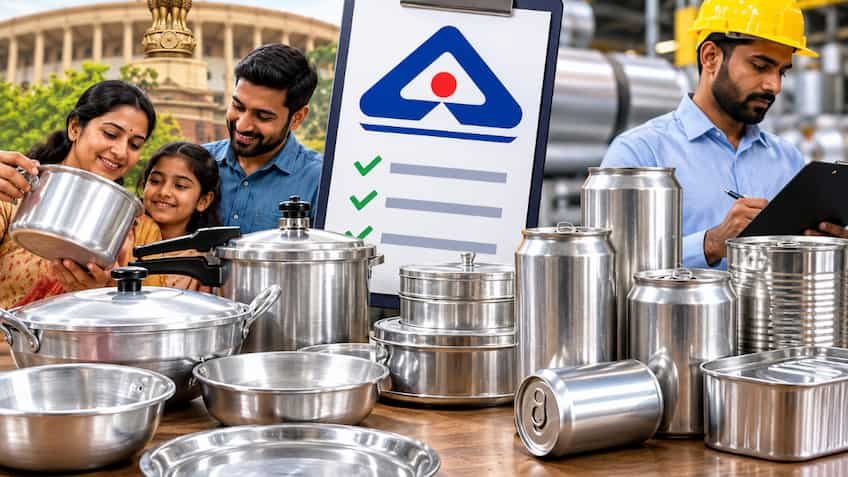
From the cooker for cooking pulses in the kitchens of Indian homes to the tea kettle and the cans of soft drinks and beer available in the market, the government has now imposed strict security measures on every item related to aluminium. The Department for Promotion of Industry and Internal Trade (DPIIT), Union Ministry of Commerce and Industry has formally notified the ‘Cookware, Utensils and Cans for Foods and Beverages (Quality Control) Order’. Under this new order of the Bureau of Indian Standards (BIS), it has been made legally mandatory to have BIS certification i.e. the famous ‘ISI’ mark on all types of aluminum utensils and beverage cans manufactured in the country and imported from abroad. This historic policy decision simply means that now no manufacturer, wholesaler, importer or local shopkeeper will be able to manufacture, store, distribute or sell substandard, adulterated or substandard aluminum utensils and cans. If any trader is found violating this order, there is a strict provision of both heavy financial fine and jail sentence under the BIS Act. This step of the government has created a stir in the utensil markets, metal rolling mills and beverage packaging industry across the country, while it is being considered as a much-awaited health protection shield for the consumers.
At the heart of this new Quality Control Order (QCO) are two most prominent Indian Standards, around which the entire quality system has been reimagined. The first standard is ‘IS 1660:2024’, which prescribes the metal composition, thickness, purity and heat tolerance of all types of utensils (kadai, patila, cooker, tawa, saucepan) made of wrought aluminium. Another important standard is ‘IS 14407:2023’ (Revised 2026), which applies to two-piece aluminum cans used for soft drinks, beer, fruit juices and energy drinks. In case of beverage can, strength of metal alone is not enough, but the layer of food-grade lacquer (Internal Coating) inside it is most important. The new BIS rule ensures that the coating applied to the interior of the can is so impermeable that carbonated drinks or acidic liquids never come in direct contact with the aluminum metal. Apart from this, double-seam leakage test of cans, high internal pressure bearing capacity and stringent weight tests have been made mandatory, so that the possibility of rupture or leakage of the bottle or can is completely eliminated.
Aluminum utensils have been the first choice among middle-class and rural households in India for decades due to their low price, light weight and fast heating capacity. But the dark truth behind this is that about 40 to 50 percent of the cheap utensils sold in the unorganized markets of the country are made by melting automobile scrap, old electrical wires and industrial waste. This recycled metal contains large amounts of highly toxic impurities like lead, cadmium, arsenic and chromium. When acidic foods like tomato, tamarind, lemon, buttermilk or vinegar are cooked in these utensils, due to chemical reaction, aluminum and these poisonous elements dissolve and get mixed directly into the food. It has been proven time and again in medical research that accumulation of excess amount of aluminum in the body increases the risk of life-threatening problems like diseases related to the nervous system, Alzheimer’s, hollow bones and kidney failure. With the new rules of BIS, the use of such impure scrap metal will now be completely banned and factories will have to use only virgin or completely pure and certified aluminum alloy.
From the point of view of the general public, this decision will act as a life-saving shield for their health. Now customers will not have to depend on any misleading claims to check the purity of utensils while shopping in the market; They will be able to confirm the quality just by looking at the ISI mark on the bottom of the vessel and the seven-digit CM/L license number. However, a natural question is arising in the minds of many consumers whether the prices of utensils will start skyrocketing due to the implementation of the standards. Experts and industry analysts believe that there will be no significant difference in the prices of branded and high-quality utensils as they already adhere to strict standards. At the same time, there may be a slight increase of 10 to 15 percent in the prices of very cheap and light utensils available from street markets or hawkers, because manufacturers will now compulsorily have to use high grade raw material. But experts clearly say that this minor price increase is completely beneficial for consumers compared to future medical expenses and diseases worth lakhs of rupees due to a substandard utensils.
The biggest impact of this order is going to be on the micro, small and medium enterprises (MSME) of the country. Thousands of small factories and casting units are involved in the manufacturing of aluminum utensils in areas like Jagadhri in Haryana, Moradabad, Mirzapur, Kanpur in Uttar Pradesh, Yahiyaganj and Aminabad metal clusters in Lucknow and Rajkot in Gujarat. Keeping in mind the financial and technical limitations of small entrepreneurs, this time the government has adopted a very practical policy of ‘phased manner’ i.e. phased compliance. This rule has become mandatory for big industrialists from October 1, 2026, while small enterprises have been given time till January 1, 2027 to prepare their labs and obtain licenses. At the same time, special exemption has been provided to the smallest and rural level micro enterprises till April 1, 2027. Despite this, setting up in-house testing labs, purchasing chemical testing equipment and meeting the audit standards of BIS remains a major economic challenge for small businesses, for which industry organizations are demanding special subsidies and common testing facility centers from the government.
In the case of beverage cans, this notification has also given a big relief to the Indian beverage industry and beer manufacturers. Last season, when there was a sudden shortage of cans, the companies had appealed to extend the deadline citing supply crisis. The implementation of the new deadline has given domestic can manufacturers ample time to increase their production capacity and invest in modern coating technology. Moreover, one of the biggest geopolitical and economic benefits of this order will be that it will immediately stop the import of cheap, sub-standard and substandard aluminum pots and cans being dumped into India from China, Vietnam and other countries. It will also be mandatory for foreign companies to get their factories audited by the Indian government under the Foreign Manufacturers Certification Scheme (FMCS) of BIS to sell goods in India. Overall, this new rule is going to prove to be a milestone in making the kitchens of Indian consumers ‘poison-free’, making domestic manufacturing globally competitive and taking the country forward towards adulteration-free quality India.