 look news india

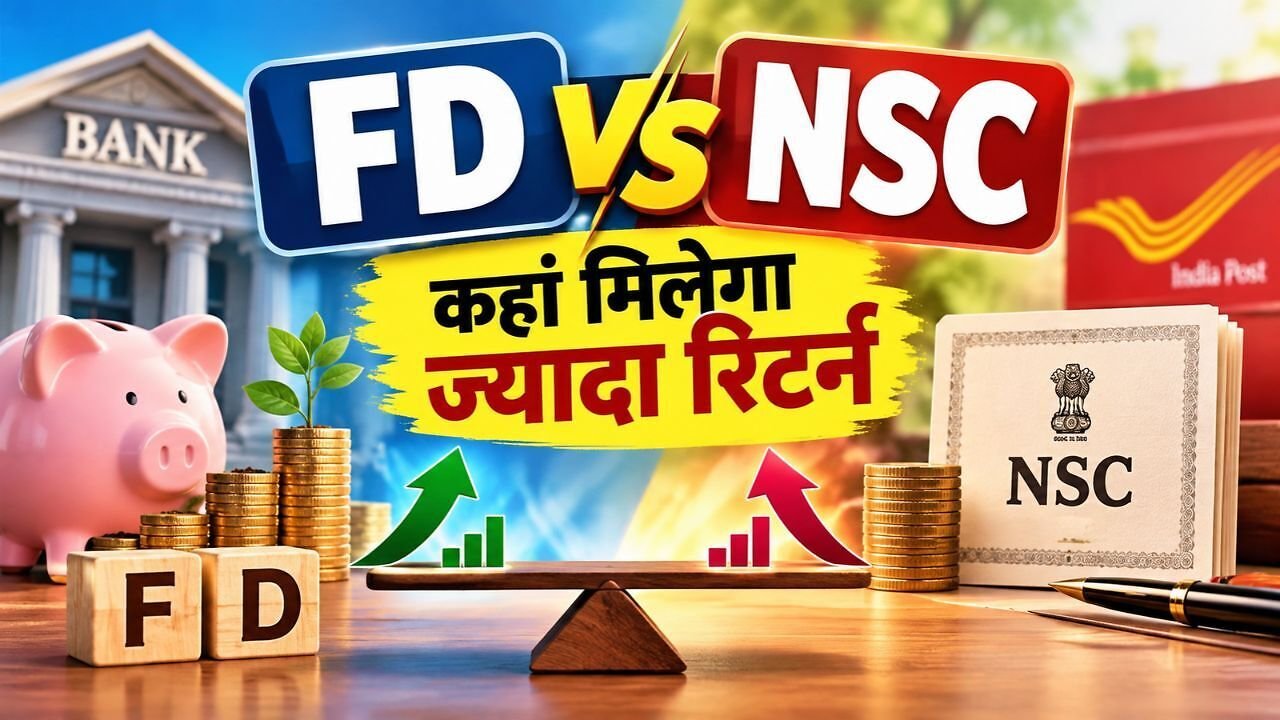
If you have a lump sum capital of ₹2,50,000 and want safe and guaranteed returns for a period of 5 years without any market risk, two traditional instruments are most popular—5-year fixed deposits (FD) of banks and National Savings Certificate (NSC) of post office. Both the schemes have the security cover of Government of India or RBI, but when it comes to the net return on maturity and compounding of interest, there is a clear difference between the two.
| comparative standards | National Savings Certificate (NSC) | Top Bank 5-Year FD (Ex. SBI/HDFC) |
| current interest rate | 7.70% p.a. | 6.50% – 7.00% p.a. |
| compounding frequency | Annual Compounding | Quarterly Compounding |
| Principal | ₹2,50,000 | ₹2,50,000 (at normal 6.75% rate) |
| Total interest earned in 5 years | ₹1,12,259 | ₹99,444 |
| Total maturity amount after 5 years | ₹3,62,259 | ₹3,49,444 |
| direct profit margin | ₹12,815 more | — |
Note: For senior citizens, banks offer 0.50% to 0.75% additional interest (about 7.25% to 7.50%) on 5-year FD, which brings the maturity of their FD to about ₹3.58 lakh to ₹3.62 lakh.
-
High interest rates: Currently on this small savings scheme of the Central Government 7.7% annual interest rate Which is 0.70% to 1.20% higher than the 5-year FD rates of most major government and private banks.
-
Sovereign Guarantee (Zero Risk): This scheme is directly backed by the Government of India, so your entire capital (principal + interest) deposited in it is 100% safe.
-
No TDS (No TDS at Source): No TDS is deducted by the post office on maturity of NSC. The entire money is transferred directly to your savings account.
-
Quarterly Compounding: One advantage of bank FD is that the interest is compounded every quarter, but due to the low interest rate, it cannot match NSC’s rate of 7.7%.
-
TDS Deduction: If your FD interest exceeds ₹40,000 (₹50,000 for senior citizens) in a financial year, the bank deducts 10% TDS as per rules.
-
DICGC Insurance Limit: Bank FD has a maximum security guarantee under DICGC up to ₹ 5 lakh.
If you file taxes under the old tax regime, both options offer the benefit of Section 80C, but the rules for tax on interest are slightly different:
-
Rebate on investment:
-
out of ₹2.5 lakh ₹1.5 lakh Investments up to Rs. 10,000 are eligible for tax deduction under Section 80C (be it a 5-year tax saver FD or NSC). No 80C exemption will be available on the remaining ₹1 lakh.
-
-
Unique rule of tax on interest earned (Re-investment advantage of NSC):
-
Bank FD: The interest earned every year is added to your income (Income from Other Sources) and is fully taxable as per your respective tax slab.
-
NSC: Since the interest accrued every year in NSC for the first 4 years is not withdrawn but gets re-invested, that interest can also be claimed as a deduction within the limit of ₹1.5 lakh under Section 80C (if your 80C limit is empty). Only the interest in the 5th year is fully taxable.
-
-
For General Category: If you are under 60 years of age, NSC is the clear winner. In this, at ₹2.5 lakh, after 5 years approx. ₹12,800 to ₹13,000 plus net returns Available and the interest rate remains locked by the government.
-
For Senior Citizens: Senior citizens can get FD rates ranging from 7.50% to 7.75% in many banks (like SBI WeCare or Small Finance Bank). Apart from this, senior citizens get tax exemption on FD interest up to ₹ 50,000 under Section 80TTB. In such a situation, senior citizens can also choose the option of bank FD.