 look news india

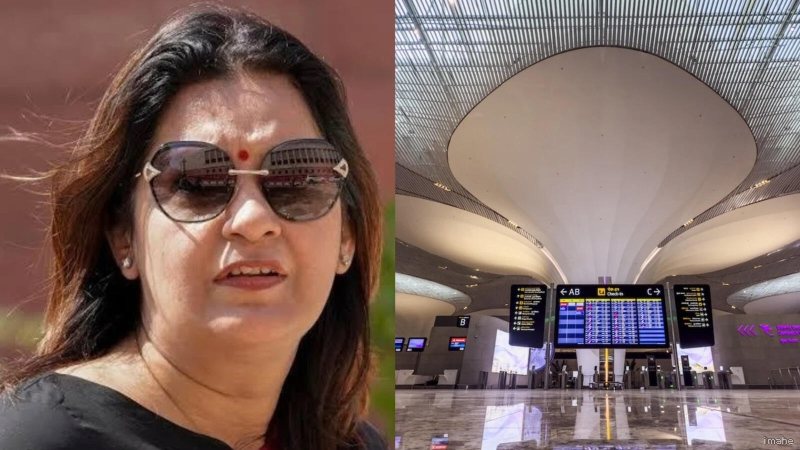
The development of infrastructure and construction of new modern airports is going on at a rapid pace in India’s aviation sector, but along with it, heated debate has also started at the political and social level regarding administrative decisions and operation of airlines. Recently, a big news related to the aviation scenario of Mumbai Metropolitan Region (MMR) has come out, in which orders have been issued to shift about 265 flights from Chhatrapati Shivaji Maharaj International Airport to the newly developing Navi Mumbai International Airport. As soon as this administrative decision came to light, there was an uproar in aviation circles and political circles. The most sharp and vocal reaction to this order has come from senior Shiv Sena (UBT) MP and fiery leader Priyanka Chaturvedi. Expressing deep displeasure over this decision, he has directly raised the question that how can it be right or justified to suddenly shift such a large number of flights, keeping in mind the actual facilities, connectivity and local preferences of the passengers. While on one hand this entire incident has brought Mumbai’s increasing air traffic and airport load management into the center of debate, on the other hand it has also raised many serious questions regarding the problems of passengers and the operational pressure of airlines.
The main Chhatrapati Shivaji Maharaj International Airport (CSMIA) of Mumbai, the country’s financial capital, is among the world’s busiest single-runway based and high-density airports. There is already a huge pressure of flights here, due to which problems like shortage of slots, delays in aircraft movement and air traffic congestion during peak hours have become common. As a permanent solution to all these problems and to distribute the increasing commercial traffic of the Mumbai region, a state-of-the-art and huge international airport has been constructed in the Panvel area of Navi Mumbai, with the aim of reducing the aviation pressure. Under this strategy, by establishing coordination between the Directorate General of Civil Aviation (DGCA), Airport Authority and the concerned airlines, a blueprint was prepared to shift about 265 daily or weekly flights from the old Mumbai Airport to the new Navi Mumbai Airport. The main argument being given for this process is that it will provide modern facilities to the passengers and will relieve the congestion at the main airport of Mumbai. However, this technical and infrastructural solution, which appears on paper, has become a big challenge and a matter of concern for passengers, airlines operators and local public representatives after coming on the ground, on which voices of opposition have now started being heard openly.
Shiv Sena (UBT) MP Priyanka Chaturvedi, registering her strong objection immediately after this order, has taken a sharp dig at the Central Government, Aviation Ministry and the concerned airport administrations. He openly raised the question on social media and various forums that pushing such a large number of flights to new airports without fully prepared public connectivity and local transport infrastructure is a complete injustice to the passengers. Priyanka Chaturvedi in her statement emphasized that people have a smooth and established network of local trains, metro, cabs and other modes of transport to reach Mumbai’s main airport, while many of the basic road and rail routes to Navi Mumbai airport are still in the process of being fully developed. He asked that if passengers who have booked their tickets months in advance or who have to travel from South Mumbai, Western Suburbs or Thane, are suddenly forced to go to Navi Mumbai, both their travel time and expense will increase manifold. He bluntly said that such arbitrary and hasty administrative decisions ignore the convenience of the general public and passengers, therefore the government and airlines should reconsider this order so that no passenger has to face mental or financial trouble.
In this entire matter, the biggest practical crisis has arisen in front of the common passengers, who are facing sudden changes in their flight schedules and departure points. In the initial phase of operation of any new airport, it is very important that public transport, especially local train connectivity, expressway linkages and bus services, are fully operational to reach there. Although work is going on rapidly on the infrastructure around Navi Mumbai Airport, the current situation is that reaching there on time from the main areas of Mumbai is still a challenging task. If airlines are forced to suddenly operate 265 flights without adequate preparation, it could lead to delays in flights, problems in baggage handling and miss-connections. Additionally, shifting ground staff, maintenance units and crew logistics from one airport to another overnight is proving to be a huge financial and technical headache for the airlines. This is why not only political representatives but many aviation experts are also of the opinion that this transition period should have been made a little gradual and well-planned, so that there is minimum inconvenience to the passengers.
There is no doubt that for a huge metropolis like Mumbai, having a second international airport is the biggest and most urgent need of the hour, because the existing airport is handling more traffic than its maximum capacity. The opening of Navi Mumbai Airport will not only give wings to the economic development of the region but will also open new avenues for international flights. But in the implementation of any big mega-project, the most important factors are the convenience of the general public, transparent communication and bringing changes in a phased manner. The issues raised by Priyanka Chaturvedi have highlighted that airport operations cannot be changed based on paper and technical data alone, but the passenger experience on the ground must also be given priority. In the coming days, the Aviation Ministry, airport operators and airlines companies will have to jointly prepare a balanced roadmap that on one hand can ensure the smooth operation of Navi Mumbai Airport and on the other hand, the common passengers of Mumbai can get complete relief from connectivity or any other kind of problems.