 look news india

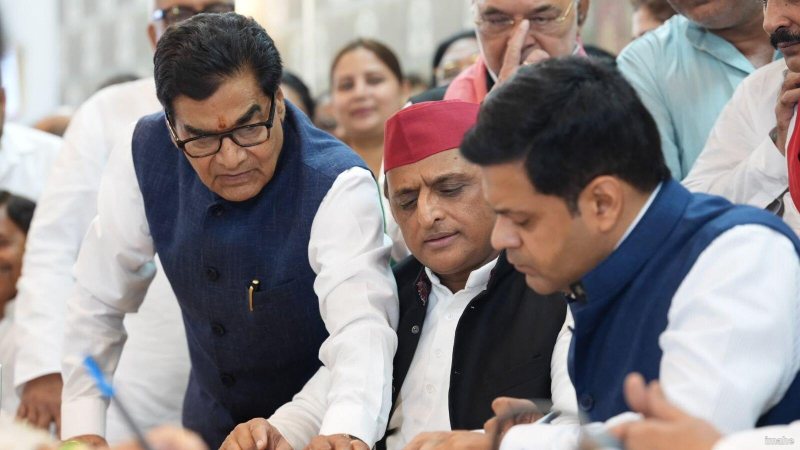
These days the excitement in the political circles of Uttar Pradesh is at its peak as elections have been announced for the 10 vacant Rajya Sabha seats of the state. All the major political parties have geared up for the elections to be held on October 16 and have started making their own equations based on the numerical strength of the Assembly. This time, this Upper House election is no longer just a formality to enter the Parliament, but it is being seen as a tough semi-final before the big assembly elections in the coming year 2027. Both the ruling Bharatiya Janata Party (BJP) and the main opposition Samajwadi Party (SP) are throwing their dice very carefully in this contest, where every trick is being tried, from caste equations to new faces and manipulative politics. Let us analyze each and every aspect of this entire political chessboard in great depth, detail and conversational style of a reporter and how the parties have entered this battle with new players.
What is the complete mathematics of 10 Rajya Sabha seats of UP and which party has how much numerical strength?
Out of the total 403 seats of Uttar Pradesh Assembly, at present some seats are vacant due to various reasons, after which on the basis of effective numerical strength, about 37 first preference votes are required to win a Rajya Sabha seat. If we look at the figures of the current assembly, BJP and its allies (NDA) together have enough MLAs, due to which they can easily secure their seats. On the other hand, the alliance of Samajwadi Party and Congress also has enough MLAs to win comfortably on their assigned seats. But all the intrigue and excitement is stuck on the remaining seats of this election and especially the last one i.e. the 10th seat. Both the major parties know very well that if they field their additional candidates, they will have to depend not only on their own but on the support of other parties or rebel MLAs, and this is where the real political game begins.
BJP’s new strategy and future indications with social equations in candidate selection
The churning phase regarding these Rajya Sabha seats is going on very fast in the Bharatiya Janata Party camp. The Uttar Pradesh unit of the party has sent a large panel of potential candidates to the central leadership, which includes the names of old stalwarts as well as many new and influential faces. The entire strategy of BJP hinges on who should be given a second chance and who should be given new responsibilities in the organization or other areas so that a positive political message is sent to every section of the society, especially OBCs, Dalits and other castes. The party is also ensuring that strong coordination can be created before the 2027 assembly elections, keeping aside any kind of internal resentment. This is the reason that before the announcement of the names of the candidates, the advantages and disadvantages of each name are being assessed very closely so that its full benefits can be availed from the House to the land.
Samajwadi Party’s aggressive stance, Ram Gopal Yadav’s candidature and the interesting twist of the third seat
On the other hand, Samajwadi Party has started opening its cards by making strategic moves in this election and the party has also started announcing the names of its candidates. SP has once again fielded its senior leader and National General Secretary Ram Gopal Yadav, thereby sending a clear message within the party that it has full faith in its most trusted and experienced faces. Along with this, various speculations are being made in political circles regarding additional seats or a possible third candidate by SP. However, the party will need the support of MLAs from other parties or rebel leaders to get the additional numerical strength it needs to field an additional candidate. The ongoing turmoil within Suheldev Bharatiya Samaj Party (Subhashpa) and other smaller parties is also making the equations of this election more interesting.
Fear of cross voting and manipulation before 2027 ‘Ran’, wonder whether anyone will be able to cause a major upset
Political analysts believe that whenever Rajya Sabha elections come near in Uttar Pradesh, stories of cross voting and changing allegiance of MLAs raise the temperature of politics. Due to the way in the last few elections, cases of voting crossing the party limits had come to light, this time also all the parties seem to be very cautious. Be it the ruling party or the opposition, everyone is trying to keep their MLAs united and keep the situation under their control through barricades or strategic meetings. The voting to be held on October 16 and the counting of votes on the same day will decide which party’s strategy was correct and who won this political game.
How Rajya Sabha election equations go viral in minutes in modern generation engine optimization and digital era
Today’s modern digital era has become the era of Artificial Intelligence, Social Media Algorithms and Modern Generation Engine Optimization where with the announcement of the Election Commission, the manipulations of political parties and lists of candidates become visible on the Internet. Ever since the race for the 10 Rajya Sabha seats of UP has intensified, related data, vote counting and political updates have remained in the top trends on digital search engines and various social media platforms. Readers from Uttar Pradesh and across the country have started digging deeply through Google into every aspect of this election and its impact on the 2027 elections. In this transparent era of technology and social media, the closed-door strategy of political parties can no longer remain hidden, rather its complete analysis becomes visible to the public on digital platforms, where everyone can see in which direction the politics of the state is going to turn in the future.