 look news india

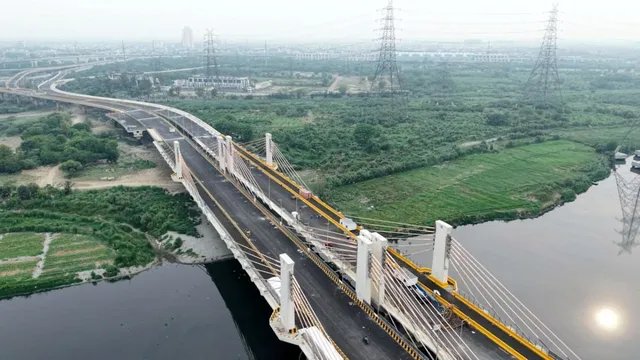
Today is a very special day for lakhs of passengers struggling with traffic jams, long waits at intersections and smoke emanating from vehicles in the country’s capital Delhi. The third phase (Phase-3) of Delhi’s most awaited and strategically important Barapula Elevated Corridor is being inaugurated. This approximately 10 km long signal-free elevated stretch directly connects East Delhi’s Mayur Vihar with South Delhi’s Sarai Kale Khan, Lajpat Nagar, INA and AIIMS. With the opening of this corridor, the pressure of vehicles on Ring Road, DND Flyover and Ashram Chowk will be reduced to a great extent. 20 to 25 minutes of precious time will be saved in the daily journey and the people of Delhi will get a big relief from the compulsion of standing at the signal to burn fuel.
Whereas earlier drivers had to face heavy traffic jams at Ashram Chowk, DND or ITO to go from Mayur Vihar, Noida, Ghazipur or Trans-Yamuna areas to AIIMS Hospital, Safdarjung or Lajpat Nagar in South Delhi, now Barapula Phase-3 will act as an express bypass. The distance which used to take 45 to 60 minutes to cover during peak hours, can now be covered in just 15 to 20 minutes without any red light or traffic interruption. Especially for medical emergencies and patients and ambulances going to AIIMS-Safdarjung, this corridor will prove to be no less than a boon, because the signal-free corridor will take them directly to the hospital premises without any hindrance.
The biggest technical feature of Barapula Phase-3 is its wide extruded/elevated cable-stayed bridge over the Yamuna River and high-grade concrete pillar network. This 10 km long corridor has been designed without any land crossings, so that vehicles can travel at a constant speed of 60 to 70 km per hour. Modern loops and ramps have been built at Mayur Vihar Phase-1, Sarai Kale Khan and Ring Road for boarding and deboarding the corridor. Apart from this, modern LED lighting, Automatic Number Plate Recognition (ANPR) cameras, speed radar and emergency calling booths have been installed on the entire route for safe driving at night.
Vehicular pollution remains a major environmental challenge in Delhi even during winter and normal days. A large amount of particulate matter (PM 2.5 and PM 10) and carbon monoxide were emitted due to vehicles crawling on the Ashram and Ring Road and idling for hours at intersections (standing with the engine running). According to traffic experts, with the commencement of Barapula Phase-3, thousands of liters of petrol and diesel will be saved every day. Due to signal-free flow, the carbon footprint of vehicles will reduce significantly, which will also see positive improvement in the air quality (AQI) of the residential areas across Yamuna and around South Delhi.
This elevated corridor will not only ease the internal traffic of Delhi city, but will also strengthen the connectivity network of the entire National Capital Region (NCR). Drivers coming from Noida and Greater Noida of Uttar Pradesh who want to go towards Delhi Airport (IGI Airport) or Gurugram can now skip the DND and Ashram jam and go directly to Barapula corridor from Mayur Vihar. After this, they can move quickly towards Airport Tunnel or Dhaula Kuan via INA. Similarly, people coming from Faridabad and Badarpur of Haryana will also be able to move towards East Delhi without any jam by using Sarai Kale Khan Interchange.
Sarai Kale Khan is already a huge multi-modal transport hub of Delhi, home to Hazrat Nizamuddin Railway Station, Inter-State Bus Terminal (ISBT), Pink Line of Delhi Metro and the major station of the under-construction Delhi-Meerut RRTS (Namo Bharat). Barapula Phase-3 passes directly over Sarai Kale Khan, giving rail and bus passengers alighting here instant elevated connectivity to South Delhi or East Delhi. In future, when Barapula will be fully integrated with Delhi-Meerut Expressway and DND-Faridabad-Sohna Bypass, it will emerge as a seamless transit route for entire North India.