 look news india

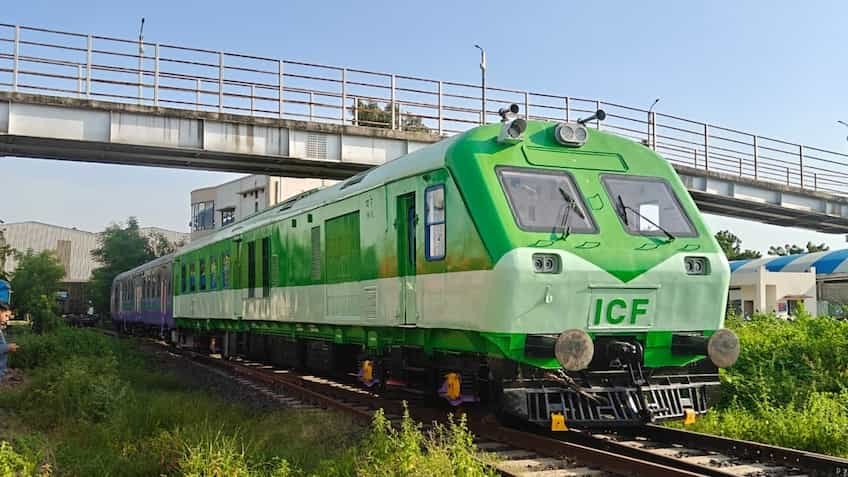
Ahmedabad/Gandhinagar. Indian Railways has taken a historic and revolutionary leap towards environmental protection, clean energy and affordable transportation. The country is going to get its first Liquefied Natural Gas (LNG) based train, which will be much more eco-friendly and fuel-efficient than conventional diesel engines. Union Home and Cooperation Minister Amit Shah will flag off this first LNG-powered train to the nation on September 27 from Sabarmati Railway Station in Gujarat. Along with this, he will also inaugurate and lay the foundation stone of several ambitious infrastructure and security projects costing more than Rs 1,542 crore for Gujarat and Ahmedabad Railway Division.
Gujarat Chief Minister Bhupendra Patel, Deputy Chief Minister Harsh Sanghvi, Minister of State for Railways, local MPs and senior administrative officials will be present in this historic ceremony. This step of Railways is going to prove to be a game-changer towards achieving the national goal of ‘Net Zero Carbon Emission’. After the successful expansion of hydrogen and electric trains, the introduction of LNG based trains is going to add a golden chapter in the modern and green history of Indian Railways.
This is the first time in the history of Indian Railways that a Liquefied Natural Gas (LNG) based dual-fuel system has been successfully integrated into the Driving Power Car (DPC) of a train. Under this pilot project, two driving power cars of 1,400 horse power (HP) capacity at Sabarmati Integrated Coaching Depot have been converted into state-of-the-art diesel-LNG dual fuel engines.
The biggest technical feature of this system is that the train engine can switch instantly between LNG and diesel as per the requirement and availability of fuel without any interruption. If there is no facility to fill LNG on any route, the train will be able to operate completely on normal diesel also. According to railway experts, this technology does not cause any decline in engine power, pulling capacity and operational reliability, rather the engine works more smoothly and quietly than before.
The use of this new technology is expected to provide huge economic benefits to Railways both at financial and operational levels:
-
40% reduction in dependence on diesel: In this dual-fuel engine, up to 40 percent of diesel consumption can be directly replaced with LNG.
-
Annual savings of lakhs of rupees: According to the data received during the trial, there will be a net fuel savings of about ₹23.9 lakh to ₹25 lakh per annum in operating an 8-coach rake due to the price of LNG being much cheaper than diesel.
-
Foreign Exchange Savings: Dependence on imported crude oil in the country will reduce, which will reduce the pressure on the railway budget due to fluctuations in fuel prices in the international market.
-
Successful trial of more than 2,000 km: Before giving commercial approval to this technology, a rigorous and successful field trial of more than 2,000 kilometers was completed on both driving power cars, in which its safety and efficiency was 100% proven.
Railway engineers have followed special safety standards regarding train design and fuel storage capacity:
-
tank capacity: Cryogenic LNG tanks with a capacity of approximately 2,200 liters have been installed in each DPC. About 950 to 1,000 kg of useful liquefied gas can be filled in it at one time.
-
Long operating range: After full filling of LNG, the train can easily cover a daily run of more than 444 kilometers in one go without refueling.
-
Safety measures: The LNG is stored in double-layered insulated cylinders at extremely controlled temperatures and high-pressure. It is equipped with leakage detection sensors and automatic shut-off valves, which stop the fuel supply in a split second in case of any emergency.
Black smoke emitted from conventional diesel trains running on urban and suburban railway routes has been a major cause of air pollution. LNG is a clean fossil fuel, burning which releases very few toxic gases.
According to the technical analysis of Railways, there has been a significant decline in emissions of carbon dioxide (CO₂), nitrogen oxides (NOx) and fine particles (Particulate Matter – PM) due to the use of LNG. This will keep the air of residential areas around the railway track clean and will greatly strengthen the Green Transportation Mission of Indian Railways.
Not only the LNG train, but also four other major projects worth ₹1,542 crore to modernize Gujarat’s rail network will be launched at the ceremony organized by Amit Shah at Sabarmati:
-
Foundation stone of ‘Kavach’ system at a cost of ₹411 crore: Indigenous automatic train protection system ‘Kavach’ will be installed on the 404 km long network of Ahmedabad division. This includes the 157 km long Ahmedabad-Palanpur and 247 km long Ahmedabad-Samakhiyali rail section. This system will prove to be perfect in preventing head-on collision of trains and preventing overspeeding.
-
₹700 crore WAG-12 locomotive shed: Newly constructed state-of-the-art Locomotive Maintenance Shed will be inaugurated at Sabarmati, which has the capacity to maintain 300 Heavy Goods Electric Locomotives (WAG-12) of 12,000 horse power each.
-
Automatic Block Signaling: Automatic signaling has been introduced on the 122.57 km rail section between Sabarmati-Kalol-Bhandu Motidau and Sabarmati-Sanand-Jakhwara at a cost of ₹118.83 crore, which will increase the speed of trains and track capacity.
-
Sabarmati-Sarkhej Railway Line Doubling: Doubling of the 21 km long Sabarmati-Sarkhej section at a cost of ₹313.27 crore is targeted to be completed by March 2028, which will give a new dimension to the connectivity of Dholera Special Investment Region (SIR).
The launch of the country’s first LNG train from Sabarmati is a decisive step towards Indian Railways’ technological self-reliance, its sensitivity towards the environment and a future Green India.