 look news india

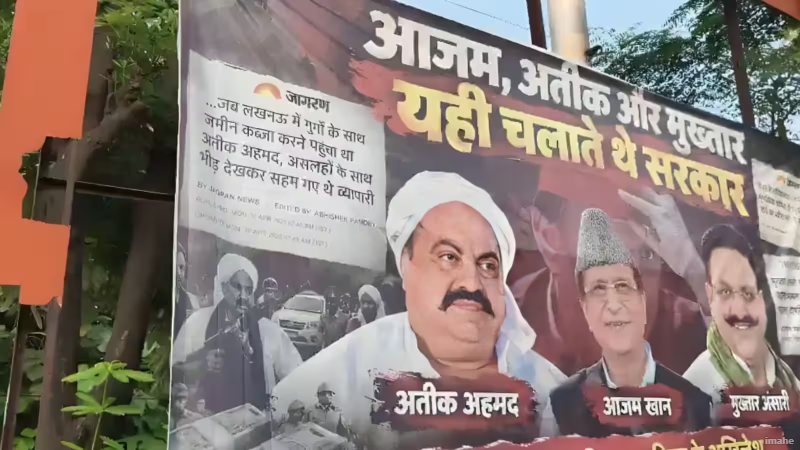
After the sharp arrows of statements in the politics of Uttar Pradesh, now a new phase of waging war through posters and hoardings has started, which has suddenly increased the political temperature of the state. Suddenly overnight, such controversial and sensational posters have been put up in many major cities of the state, the sharp slogans written on them have given sleepless nights to the opposition parties. In these posters, directly targeting the Samajwadi Party (SP) regime, it is written in big letters that ‘Azam, Atiq and Mukhtar, they used to run the government’. As soon as this poster war has come to light, there has been panic in the political circles and the war of words between the leaders of the party and the opposition has once again reached its peak. The installation of such hoardings in Uttar Pradesh, which has always been sensitive on law and order issues, indicates that the political temperature is going to rise further in the coming days.
In Indian politics, be it election season or ordinary day, the culture of protesting and drawing public attention through posters is very old. But when serious allegations of criminal protection are made against a political party by directly linking the names of powerful leaders and previously famous faces in the posters, then the matter is not limited to just one banner, but takes the form of a big ideological and electoral struggle. These posters put up at different intersections and major roads of Uttar Pradesh have not only attracted the attention of the passers-by, but have also sparked debate on social media. Let us know in detail what is the real political background behind this new poster war and what could be its far-reaching consequences.
This latest incident of poster war has been seen simultaneously in many districts of Uttar Pradesh, where these hoardings put up by unknown people have shocked everyone. The posters use names and references to controversial and high-profile political figures like Atiq Ahmed, Mukhtar Ansari and Azam Khan, who have been in the news for a long time due to legal entanglements, jail or criminal cases. Through these posters, an attempt has been made to convey the message that how parallel system and mafia rule prevailed during the previous governments. As soon as common citizens and local leaders saw these posters in the morning, the commotion among the administrative staff also intensified and the police administration started taking action to remove them.
Political analysts believe that the sudden and well-planned posting of such posters could be part of a well-thought-out strategy. Whenever tough decisions are taken at the governance and administration level or old incidents are made a part of ideological debate, such propaganda tools are used to strengthen the political ground. There is a huge resentment among the opposition parties and especially the Samajwadi Party workers regarding these posters, because they believe that all this is being done as part of a sponsored conspiracy to pollute the upcoming political environment and tarnish the image of their party.
After the appearance of these posters, a very strict and aggressive stance has been adopted by the Samajwadi Party. Senior SP leaders and spokespersons have launched a strong attack on the ruling party and opposition forces through press conferences and social media. SP says that such cheap tactics are proof that the opposition party has nothing left to talk about on real issues related to development, employment and public, hence they want to win the elections only with the help of petty politics and polarization. Party leaders also alleged that the present government in the state is resorting to such sponsored poster wars to hide its failures and divert public attention from inflation, unemployment and other law and order problems.
Samajwadi Party workers have also protested against these posters at many places and have demanded from the administration that the anarchists who put up such inflammatory and derogatory hoardings should be identified and the strictest legal action should be taken against them. SP argues that it is natural to have ideological opposition in a democracy, but no one should be given the freedom to spread hatred in the society through personal attacks and such objectionable posters. After this sharp protest, the police administration has also become fully alert in many parts of the state and efforts are being made to find out who was behind the printing and installation of these posters.
If we look at the history of politics of Uttar Pradesh, the issue of law and order and cracking down on mafias has always been at the center of every election and political debate. The present ruling party has been continuously claiming that since the coming of their government, organized crime and mafia rule have been completely eliminated in the state, and fear of law has been created in the minds of criminals. On the other hand, the opposition alleges that the regime is targeting only selected people and the law is being used for political vendetta. In the midst of this entire debate, when the poster war starts with names like ‘Azam, Atiq and Mukhtar’, it refreshes the old memories of the public and once again the old chapters of security and crime start openly discussed.
The general public and middle class voters follow these issues very closely. On one hand, people talking about security and peace remember the shortcomings of the old governments through such posters, on the other hand, citizens demanding fairness also want that politics should not be limited to the narrative of fear and crime and should be focused on basic questions like education, health and development. This mixed reaction of the public is proof that the voters of Uttar Pradesh now examine every propaganda of political parties very intelligently.
As political activities are intensifying in Uttar Pradesh, there is every possibility that this type of poster war and rhetoric will increase further. Political parties, as part of their respective strategies, are trying to create such an environment among the public that the ideological ground in their favor can be strengthened. However, it will be very interesting to see whether such emotional and controversial issues will be able to push back the real and day-to-day issues of the common people or will the public take its decision on the development agenda only. Political experts believe that such immediate controversies definitely grab headlines for some time, but in the long run, ground work and public interest issues play the biggest role in deciding the course of elections.