 look news india

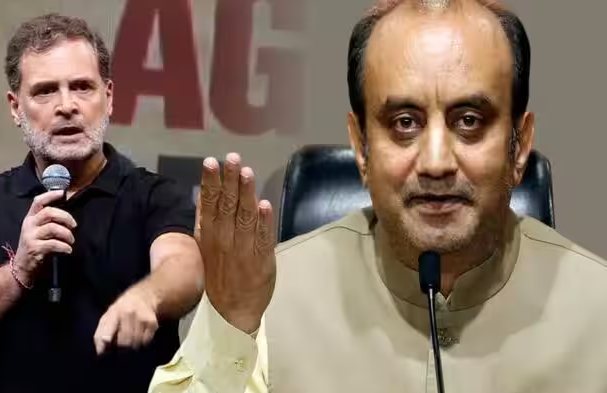
There has once again been a fierce battle in Indian political circles over ideological and religious nationalism. The statement regarding ‘Hindu nationalism’ given by the country’s former Vice President Hamid Ansari has created a huge upheaval in national politics. As soon as this statement came to light, Bharatiya Janata Party (BJP) has become completely aggressive and has launched a scathing attack on the main opposition party Congress Party as well as Rahul Gandhi. BJP has alleged that today’s Congress Party has completely come under the influence of ‘ultra left’ ideology and it is continuously targeting the basic culture of the country. Since this controversy has gained momentum, the war of words between the ruling party and the opposition has intensified, in which the views of the country’s first Prime Minister Pandit Jawaharlal Nehru are also being openly mentioned. Let us know where this whole controversy started and what is its political meaning.
The controversy began when Hamid Ansari, at a public event or forum, expressed serious concern about the growing majoritarian and Hindu nationalistic tendencies in the country. His statement immediately got support from the opposition parties, but the ruling Bharatiya Janata Party called it a direct attack on the cultural identity of the country and the sentiments of the majority society. BJP says that such statements are made deliberately to weaken the social fabric of the country and under a specific ideological agenda. Political analysts believe that as the electoral atmosphere and political excitement is increasing in the country, the rhetoric on ideological issues is also becoming more sharp, which will decide the direction of future politics.
BJP’s strong counterattack: “Today’s Congress has completely become ultra left”
After Hamid Ansari’s statement, BJP’s national spokesperson and senior leaders held a press conference and fiercely targeted the Congress party. BJP said in strong words that the Congress party has now completely deviated from its old centrist and national trend and has become a puppet in the hands of ‘ultra left’ i.e. extreme leftist forces. Party leaders allege that Congress and its allies have always been trying to degrade India’s cultural identity and the faith of the majority society. BJP also said that the people of the country understand this kind of appeasement and divisive politics very well and when the time comes, they will give a befitting reply to it in a democratic manner.
In this attack, BJP also took a dig at Rahul Gandhi’s working style and the statements made during his political tours. Saffron Party says that under the leadership of Rahul Gandhi, the Congress Party is constantly seen standing with the forces that are anti-national and dividing the nation. Whenever there is an attack on the country’s eternal culture or nationalism, Congress leaders either support it or maintain silence. BJP bluntly said that India is a cultural nation and no individual or ideological group can weaken it for their political selfishness. The people of the country are completely united on the issue of nationalism and such statements by the opposition parties will not harm the unity of the country.
Controversy broke out on the pages of history by mentioning the thoughts of Pandit Jawaharlal Nehru.
In this entire political controversy, the statements and policies of the country’s first Prime Minister Pandit Jawaharlal Nehru are also being mentioned prominently. Taking on the Congress party, the BJP said that those who are opposing ‘Hindu nationalism’ or Indian culture today should read the historical writings of their own party’s founder and the country’s first Prime Minister Nehru and books like ‘Discovery of India’. BJP argued that Nehru ji had also deeply felt the ancient culture of India, its continuity and inherent unity, but today’s Congress is completely cut off from its own ideological history and is ready to go to any extent just to gain power.
On the other hand, Congress and other opposition parties have completely rejected all these allegations of BJP and said that the ruling party is deliberately fanning such ideological disputes to divert public attention from basic issues like inflation, unemployment and economic inequality. The opposition argues that the Indian Constitution grants all citizens the right to express their views and ideological freedom, and if a scholar or politician expresses his views on the country’s Constitution and secular fabric, it should not be considered treason or an insult to culture. It is the duty of every Indian to protect the Preamble of the Constitution and its values, and any kind of majoritarian pressure is not good for democratic institutions.
What will be the long-term impact of this ideological conflict on the country’s politics?
As this controversy is progressing, it is becoming clear that the issue of ‘nationalism’ is once again going to become the focal point in national politics in the coming days. On one hand, BJP is seeing it as an opportunity to further strengthen its ideology of Hindutva and cultural nationalism, while the opposition is presenting it as a fight to protect the Constitution, democracy and secularism. Such ideological conflicts accelerate both political awareness and polarization even among the general public. Only time will tell how effective this issue will prove to be in terms of elections, but for now, this rhetoric has once again heated up the political scene in the country.
Keeping in view the upcoming elections and regional equations in various states, all the political parties have started working on their respective strategies. This statement of Hamid Ansari and the political reaction to it have proved how sensitive and deep the ideological debates are in India. As long as political parties continue to give importance to such ideological battles rather than issues of real development of the people, the mainstream politics of the country will continue to revolve around such conflicts. The aware citizens of the country have now started understanding the political hidden behind these statements, which is the biggest proof of the maturity of Indian democracy.