 look news india

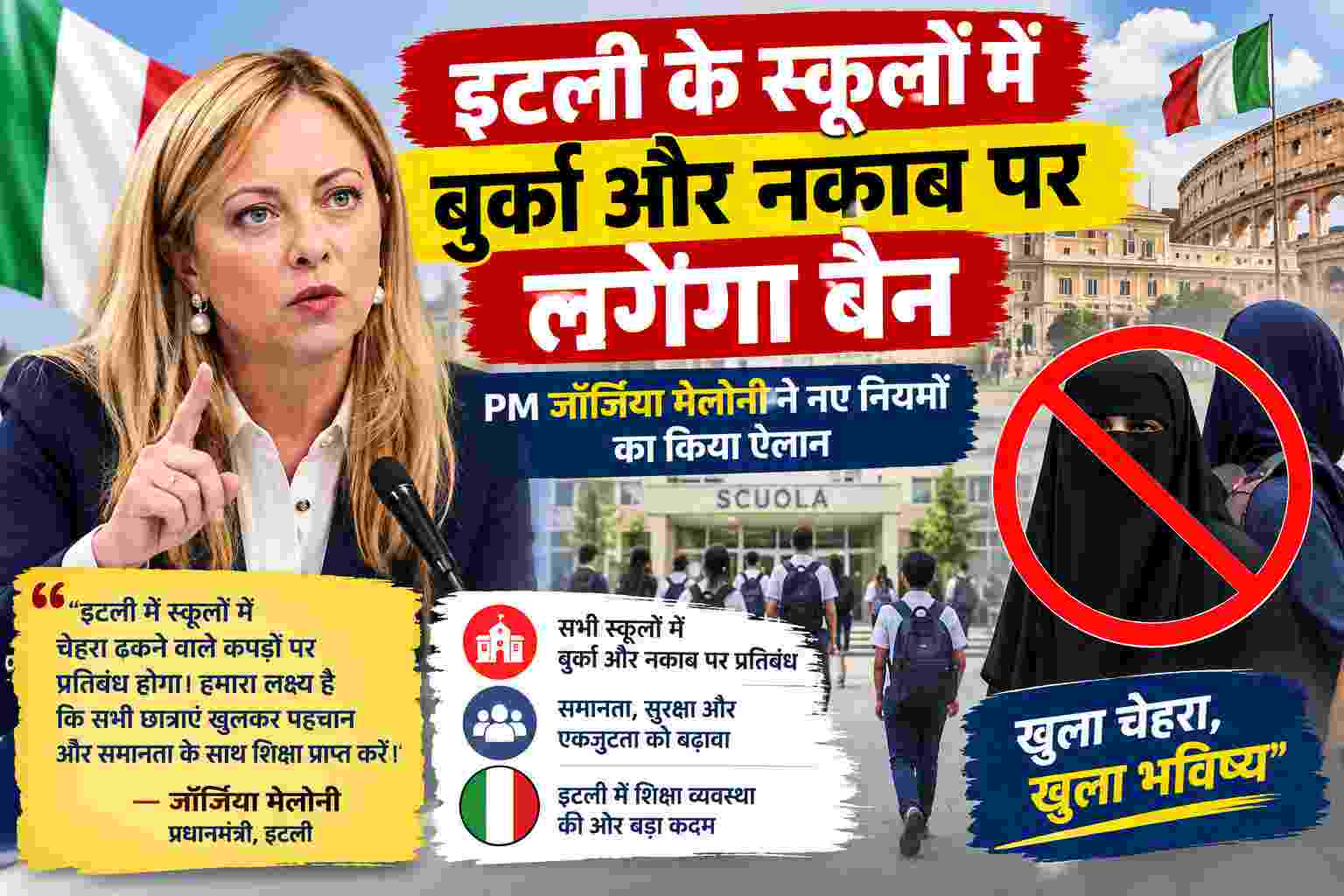
A major policy change is being seen in the European country Italy regarding education and migration policies. Italy’s Prime Minister Georgia Meloni has made a clear announcement that there will be a legal ban on dresses that completely cover the face like burqa and niqab in the country’s schools. Addressing the national conference of the youth front of his party ‘Brothers of Italy’ held in Rome, Meloni said that no student can be allowed to come to school with his face covered. No girl can be forced to hide herself in the name of tradition or religion. Along with this decision, a proposal to limit the number of students of foreign origin in classes is also being brought in the cabinet, which has sparked a new debate in the political circles across Europe.
Prime Minister Georgia Meloni made it clear in her address that it will be mandatory for every student coming to Italian schools to have an uncovered face. He said that under the guise of tradition, no woman or student can be allowed to remain covered in niqab in the school premises.
The proposed rules primarily ban garments that cover the entire face, including burqas and niqabs. Niqab usually leaves only the eyes open and burqa covers the entire body and face with a net curtain. However, there is no mention of any separate ban on the normal hijab (which covers only the head and hair and leaves the face completely exposed). The government believes that it is extremely important for direct communication between teachers and students within the classroom, clarity of identity and safety to remain open. This draft will soon be placed before the Cabinet, after which it is to be presented in Parliament for approval.
Along with the burqa ban, the Meloni government has taken another tough step and has prepared a proposal to set a maximum limit for foreign students in each class. Meloni stressed that Italian children in Italian schools should not feel like a minority within their own classes.
Meloni argues that if one or two children in a class do not understand the local Italian language, teachers and classmates can help them and they easily integrate into the mainstream. On the contrary, if the number of foreign students who do not know the local language in a class becomes very large or they become the majority, the quality of education is affected. According to Meloni, such a situation would not be called social integration but ‘negligence’ of the system. According to data from the research institute Fondazione ISMU, about 11.6 percent of the total students enrolled in Italian schools are those who do not have Italian citizenship. Under the new rules, now a certain percentage or number of foreign students will be fixed for every class.
In this new bill of the government, the rules are not limited only to the students, but their families have also been brought under its purview. According to the new proposal, it could be made mandatory for the parents of foreign students who are facing serious difficulties in assimilating into the Italian education system and society, for their parents to learn the Italian language.
The government believes that educational development of children at home will not be possible unless parents acquire basic knowledge of the local language and culture. Meloni said in clear words that anyone who wants to make his future in Italy will have to respect the rules of the country and adopt the local language. This requirement of language is being brought with the aim of connecting the migrants with the mainstream of the society and preventing the creation of isolated settlements (ghettos).
This proposed law of Italy is a link to a series of policies already running in Europe under which restrictions have been imposed on covering the face in public places. France imposed a nationwide ban on any face-covering clothing in public in 2011. Apart from this, countries like Belgium, Austria, Denmark and Switzerland have also imposed strict restrictions on full face covering masks in public places. A partial ban on face coverings is already in place in the Netherlands in schools, government buildings and public transport.
After this announcement by the Meloni government in Italy, while right-wingers and local supporters are calling it a necessary step for national identity, security and transparent education system, human rights organizations and opposition parties are calling it discriminatory towards migrants and an attack on their personal rights. When this bill reaches the Italian Cabinet and Parliament in the coming days, it is certain that there will be a detailed legal and political debate on it.