 look news india

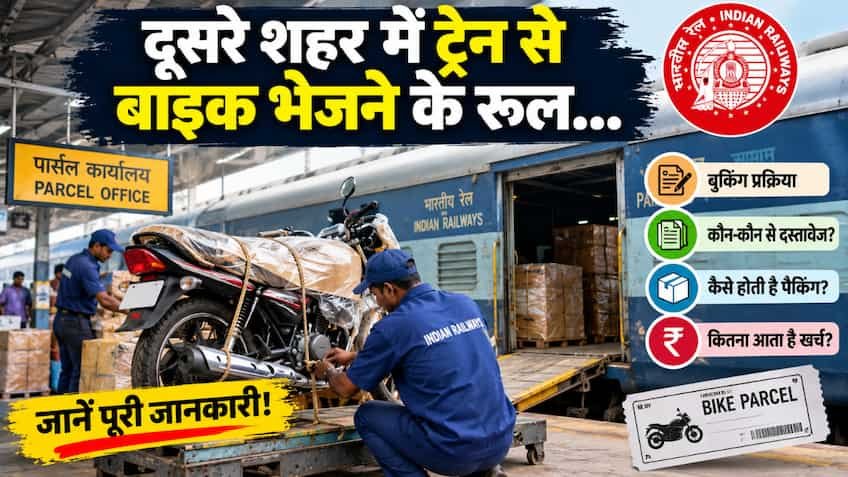
Be it a job transfer, moving to another city for higher education or shifting to a new state, transporting a two-wheeler (bike or scooter) to the new address in a safe and economical manner becomes a big challenge. While carrying a bike over long distances by road is tiring and risky, the expenses of private movers and packers companies are quite high. In such a situation, parcel and luggage service of Indian Railways proves to be the safest, fastest and economical option. You can send your bike through railways in two ways – as ‘parcel’ or as ‘luggage’. Let us understand the booking process, required documents, safety rules and railway charges in detail.
There are two main means of sending two-wheelers in Railways and both have different rules:
-
In the form of luggage: If you are traveling by yourself in the same train, you can book your bike as luggage. For this, it is mandatory for you to have a confirmed or valid travel ticket of the same train. Its biggest advantage is that your bike is loaded in the brake van (luggage bogie) of the same train in which you are travelling. You can receive your bike immediately as soon as the train stops at the destination station.
-
As Parcel: If you have to send only the bike and you are not traveling by that train yourself, then it is called parcel. Under Parcel Booking, Railways, based on its convenience and available space, transports your bike to the destination in the parcel van of any goods train or express train going on that route. It may take 2 to 5 days for the bike to reach.
Before going to the parcel counter at the railway station, make sure that you have the originals and at least two photocopies of all these documents:
-
Vehicle Registration Certificate (RC): The bike should be registered in your name. If the bike is in the name of a relative, then carry a written No Objection Certificate (NOC) from them and their ID.
-
Valid Insurance Policy: Active insurance paper of the vehicle is mandatory. Railways decides the claim coverage on the basis of insurance value only.
-
Pollution Control Certificate (PUC): Must have valid pollution certificate.
-
Identity Card: Valid photo identity card issued by the government of the vehicle owner (such as driving license, PAN card or passport).
-
Confirmed Rail Ticket: If you are booking the vehicle as luggage, a confirmed ticket for your journey is required.
Carrying inflammable substances in a train is illegal and a punishable offense under the Railway Safety Act. Therefore, before going to the booking counter, keep these things in mind:
-
Drain the petrol completely: There should not be any petrol in the fuel tank of the bike. At the parcel office, the officer first checks the carburettor or fuel inlet. If petrol is found in the tank, the Railways can impose a fine ranging from Rs 1,000 to Rs 5,000 or cancel the booking. Therefore, before reaching the station, keep only that much petrol so that you can reach there, and take out the remaining oil in a bottle.
-
Strong Packing (Bike Packing): Authorized and professional packers are available at the station premises. They pack the bike’s indicators, headlight, rear-view mirror, silencer and fuel tank tightly with cardboard, bubble wrap and jute sacks for a fee of around Rs 300 to Rs 500.
-
Marking and Name Slip: The name of the vehicle owner, mobile number, origin and destination station are written in big and clear letters with a marker on a white cloth or chart on the top of the packing, so that there is no confusion in the identification of the goods.
The total cost of sending a bike by train depends on three main components: Distance, Vehicle Weight (CC) and Declared Value.
-
Railway freight charges: The average weight of a normal bike ranging from 100 cc to 150 cc is estimated to be around 120 to 150 kg. The basic freight charge of the Railways for a distance of 500 to 1,000 kilometers usually ranges between Rs 1,200 to Rs 2,500.
-
Packing Charge: The fee charged by packers at the station is usually Rs 300 to Rs 500.
-
Railway Insurance/Valuation Charges: Railways charges a security/insurance fee of approximately 1% on the declared value of your bike that you enter in the booking form. If there is any breakage or damage on the way, the Railways gives compensation on this basis.
-
Handling/Porter Charges: A normal charge of around Rs 100 to 200 for loading and unloading is collected in receipt or by the ground staff.
(Overall, for a journey of 1,000 km the bike can easily be priced within Rs 2,000 to Rs 3,500 on an average.)
The process of receiving delivery once you reach the destination station is extremely simple:
-
The bike is unloaded at the parcel office of the destination station.
-
You have to go to the parcel office counter with your original parcel receipt (Railway Receipt / RR) and identity card.
-
There the gate pass is issued after getting the documents verified.
-
If the bike remains parked at the warehouse beyond the stipulated time of arrival (usually 6 to 12 hours of free time), the Railways may charge a nominal ‘wharfage’ or ground rent on an hourly basis.
-
You can unpack your bike by showing the gate pass. Keep in mind that while taking delivery, carry petrol in a bottle with you, because since the tank is empty, you will need fuel immediately to start the bike.