 look news india

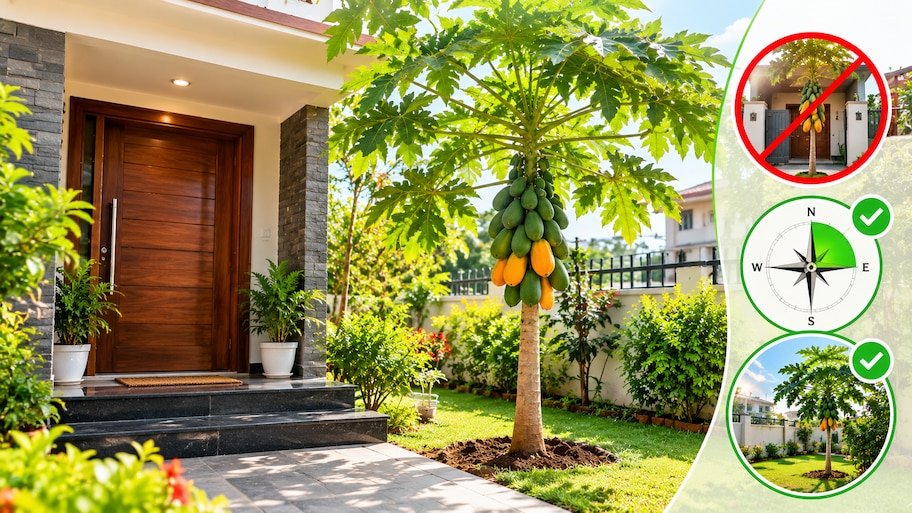
In Sanatan tradition and Vastu Shastra, the trees and plants planted around the house are considered to be directly related to the health, mental peace and financial condition of the members living in the house. In cities and rural towns like Lucknow, Delhi, Varanasi, Patna, Bhopal or Jaipur, people are very fond of planting fruit trees in their gardens, courtyards or on the vacant land right in front of the main door of their homes. One of these very common and easy-to-grow fruits is Papaya Tree. Due to its sweet fruits and medicinal properties, many people plant it with great enthusiasm right in front of the house or near the main entrance. But do you know that according to the rules of Vastu Shastra, a papaya tree planted right in front of the house or in the wrong direction can cause many types of Vastu defects and financial obstacles for the family? Vastu experts believe that before planting any fruit plant, it is very important to understand its correct direction and nature.
According to the ancient texts of Vastu Shastra, it is not considered auspicious to have any kind of fruit tree emitting milky juice (Latex) or having a weak stem, right in front of the main entrance of the house. When the stem, leaves and raw fruit of papaya are broken, white thick milk-like juice comes out from it. In Vastu science, such plants are considered to attract negative energy.
If the papaya tree is situated right in front of the entrance of the house, it is considered as ‘Dwar Vedha’ dosha. It is believed that Goddess Lakshmi, the goddess of positive energy, happiness and wealth, enters the house through the main door. When a papaya tree stands right in front of the door, it creates a blockage in the flow of divine energy coming into the house. Due to its effect, the health of the head of the household may be adversely affected and a situation of unnecessary tension and discord may arise among the family members. Apart from this, there is also a belief that there will be obstacles in the career and mental development of children.
Directions have great importance in Vastu Shastra. The East and North directions of the house are considered very sacred and divine places. Ishan Kon (North-East) is the direction of knowledge, prosperity and Lord Shiva and the gods. The basic rule of Vastu is that the East and North direction should always be kept open, light and clean, so that fresh morning sunlight and positive energy can enter the house from there.
The papaya tree grows tall rapidly and its large leaves create dense shade. If it is placed in the east, north or north-east corner of the house, it blocks the positive atmosphere of that direction. According to Vastu experts, a papaya tree planted in the north direction slows down the influence of Kuber Dev, due to which wastage of money in the house increases and the accumulated capital gradually starts getting lost. Its presence in the east direction can lead to loss of respect and social prestige.
Vastu Shastra does not talk about completely abandoning any plant, but decides the exact energy field i.e. the right direction for it. If you want to plant a papaya tree within your garden or boundary, then it is considered best to choose the following directions:
-
South-West Direction (South-West Angle): The south-west corner of the house is considered most favorable for papaya tree. This direction symbolizes stability and the earth element. By planting tall and heavy trees here, this corner becomes heavy and strong, which increases the influence of the head of the house and provides relief from household troubles.
-
West Direction: Papaya tree can also be planted in the west direction. This direction is associated with Saturn and Neptune. The fruit tree planted here helps in maintaining prosperity and stability in the house.
-
South Direction: If there is enough open space behind the house and it falls in the south direction, then papaya can be planted there also. Just be careful that the height of the tree does not overly press the main level of the roof of the house.
Along with Vastu, if seen from botanical and practical point of view, it is not considered safe to plant papaya tree near the main wall or foundation of the house. Papaya roots are shallow but they spread rapidly underground and in search of water can create moisture in the foundation of walls. Apart from this, the stem of papaya is not hard like wood but fibrous and hollow. During strong storms or torrential rains, papaya trees bearing heavy fruits often break from the middle and fall down. If this tree is planted very close to the main door or window of the house, its breakage during a storm can cause loss of life and property and can also damage the electrical wires of the house.
If a papaya tree is already planted in front of your house or in the East-North direction and you do not want to remove it immediately or are emotionally attached, then some easy measures can be adopted to remove Vaastu Dosha:
-
Plant Tulsi and Shami: Plant holy basil (Tulsi) and Shami near the papaya tree or on either side of your main door. The sattvic energy of Tulsi balances the negative effects emanating from papaya to a great extent.
-
Swastika and Copper Sun: Make an auspicious Swastika symbol with vermilion above the main door of the house or install a Surya Yantra made of copper. Due to this, the energy entering the house remains pure and positive.
-
Keep trees trimmed: Keep in mind that dry papaya leaves or rotten fruits should never be scattered on the ground. Maintain regular cleanliness around the tree and do not let its branches touch the main door frame.
-
If it dries on its own, remove it immediately: There is a strict rule of Vastu Shastra that if a fruit tree dries up on its own in the courtyard of the house, it should be immediately removed along with its roots. A dried papaya tree can invite great misfortune and disease into the house.