 look news india

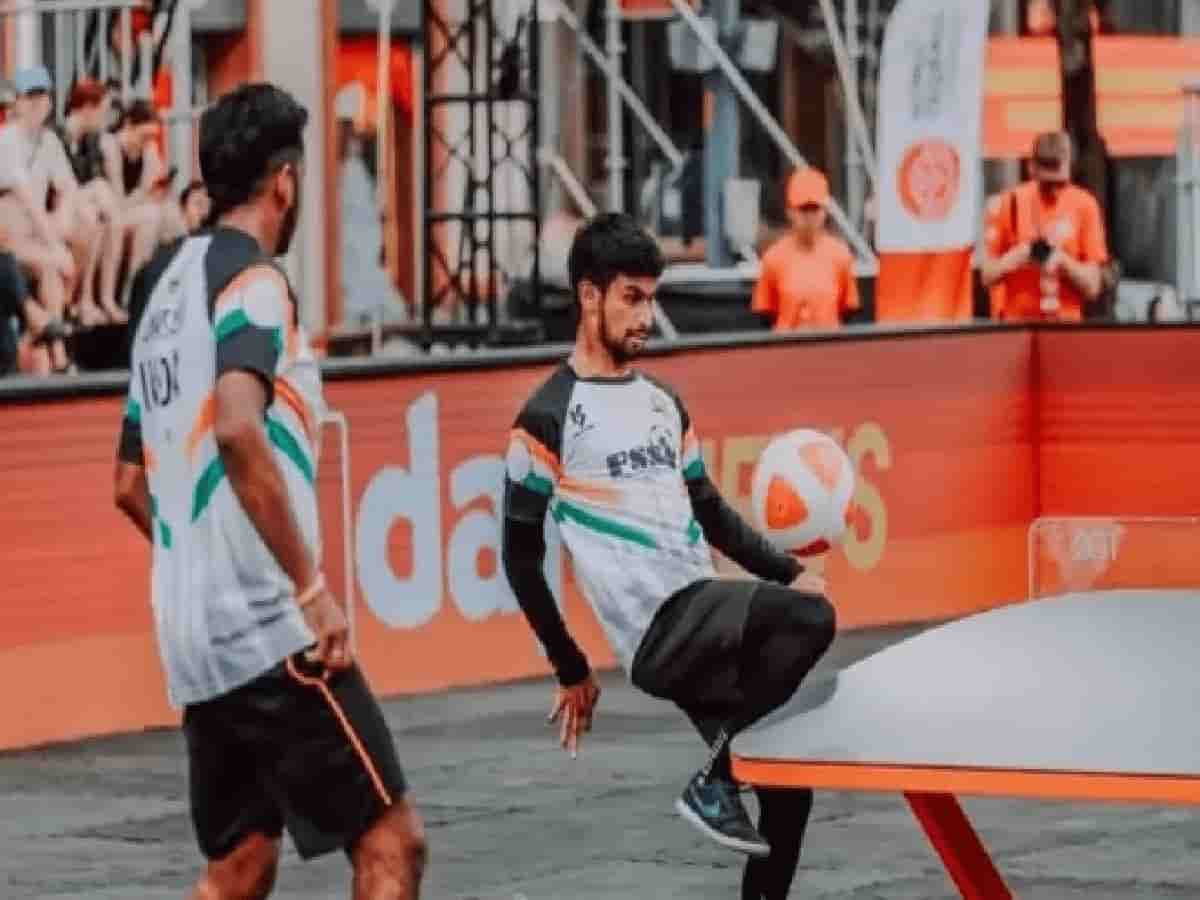
The 20th Asian Games is set to formally begin from September 19 in Aichi-Nagoya, Japan, and this time, sports fans are eyeing not only the traditional competitions but also the new adventure that is about to enter the main stage of the Olympic Council of Asia (OCA) for the first time. During 2023 in Hangzhou, China, India had created a new record by touching the historical figure of 107 medals, which this time the Indian team will enter the field with the intention of taking it further. But amidst this entire event, the game that is being discussed the most is a unique combination of the craze of football and the fast pace of table tennis – which the world knows by the name of ‘Techball’. For the modern audience who love fast pace, amazing acrobatics and unpredictable turns, Teqball is going to be the biggest attraction of this year’s Asian Games.
To understand Teqball in simple words, it is a modern incarnation of football played on a special table of the size of traditional table tennis. In this, the players’ physical ability, flexibility, first-touch control and artistry of freestyle football are seen together. The game is played in both singles and doubles formats. In singles, two players and in doubles, pairs of two players each stand facing each other on a specially prepared curved table. Right in the middle of the table is a hard net or raised divider, over which players have to toss a normal-sized football into the opponent’s court. The pace of the game is so fast that the score changes in the blink of an eye, causing the heartbeats of the spectators present on the field as well as those watching on the screen to speed up.
What makes Teqball different from all other racket or table games in the world is its surface. It is not flat, but is made in a curved design sloping downwards at both the ends. When a standard football falls on this sloped surface, it bounces at unexpected angles. The player can never decide in advance whether the ball will bounce straight or will cut sharply and run outwards. For this reason, the eye-body coordination of the players in this game should be of extraordinary level. To receive the ball, players have to jump in the air and resort to artistic moves like bicycle kick, back-volley, header and chest trap. Because of this geometry of the table, the player has to decide in a hundredth of a second at what angle to hit the ball so that the opponent player makes a mistake in picking it up.
Teqball has very strict requirements for technical accuracy. Respecting the basic spirit of football, the use of hands and arms is completely prohibited in this game. Players can use their legs, knees, thighs, chest, shoulders and head to stop the ball and send it into the opponent’s court. A player can touch the ball a maximum of three times with his body before sending it across the table, but there is a very strict rule that he cannot touch the ball with the same part of his body twice in a row. For example, if a player has blocked the ball with his chest, the next touch must be with his feet or head. If the ball touches the ground, gets stuck in the net, leaves the surface of the table, or a player inadvertently touches the ball with his hand, a point is immediately awarded to the opposing team. Additionally, service is changed after every two points to maintain balance and fairness in the game.
In accordance with international standards, official Teqball matches are played on a ‘best-of-three’ set basis. Each set is worth 12 points, and the first player or pair to score 12 points wins that set. However, if the match between the two sides is tied at 11-11, then the game continues until one of the sides maintains a clear lead of two points continuously. If both the teams are tied after winning one set each, then the match is decided in the third and deciding set. This format becomes extremely stressful in the knockout stages as a small technical error can turn the entire match upside down. Players not only have to rely on their offensive skills but also have to keep their defensive tactics rock-solid.
The history of Teqball is not very old, but its development journey has been extremely inspiring. This game started in Hungary in the year 2014, where some former professional players and computer scientists who were passionate about football, together thought of creating a practice device that could improve the ball control of footballers. When he started playing with the ball on this rotating table, he realized that it could become not just a training drill but an independent and highly competitive sport in its own right. After this, International Techball Federation i.e. FITEQ was formed, which gave it global recognition. In the last decade, this game has spread beyond the borders of Europe and has spread rapidly to dozens of countries in America, Latin America, Africa and Asia. Great football legends like Ronaldinho have also played an important role in its promotion. Based on its popularity in the Asian continent, it has proven its usefulness in the Asian Beach Games, Asian Youth Games and South-East Asian Games and has now set a new milestone by being included as an official medal event in the main event of the 2026 Aichi-Nagoya Asian Games.