 look news india

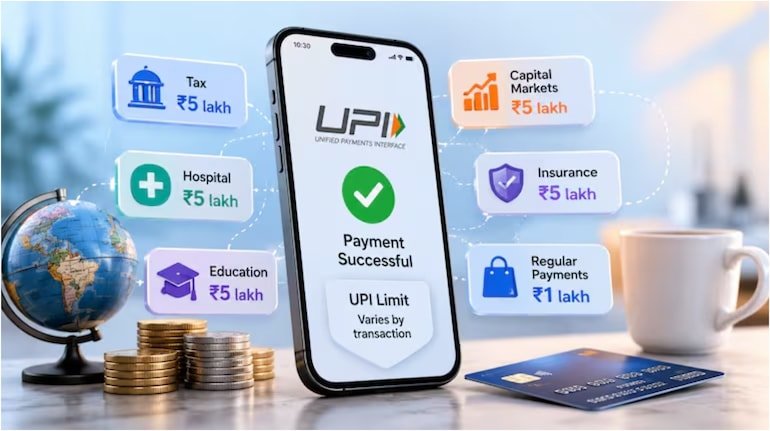
A very important news has come to light for crores of citizens and businessmen who conduct daily transactions through Unified Payments Interface (UPI) across the country. A senior central government official has made it clear that the government has no plans to withdraw its proposal or decision to implement 0.4 percent merchant discount rate (MDR) on UPI transactions. After this statement, there has been a stir in the digital payment sector, banking industry and retail market. The speculations that have been going on for a long time have now come to an end that the government may postpone this decision due to pressure from the industry or businessmen. According to the official, it has become mandatory to take this step to keep the digital payment infrastructure sustainable, secure and economically viable in the long run.
The UPI network, which has become the face of the digital revolution in India, has taken the cashless economy to every village and street in the last few years. From vegetable stalls to big shopping malls, UPI has become an integral part of every Indian’s smartphone. However, to run such a large network smoothly, banks, Payment Service Providers (PSPs) and National Payments Corporation of India (NPCI) have to invest huge capital on server maintenance, cyber security and technical upgrades. Till now, the government had been giving special incentive packages to compensate for this loss, but financial experts believe that instead of continuously depending on the government treasury, it is necessary to make this model self-reliant.
Merchant Discount Rate i.e. MDR is the fee that is charged from the merchant (shopkeeper or merchant) for providing the facility of any digital transaction. In simple words, when a customer makes a payment by scanning a QR code or through a UPI app, there are multiple parties involved in processing that transaction—the customer’s bank, the merchant’s bank, the UPI switch and the app provider. The rate of 0.4% means that for every Rs 1000 transaction, a maximum of Rs 4 will be charged.
The senior government official also underlined that this rate has been kept much lower and more balanced than the traditional MDR charged on credit cards and debit cards (which usually ranges from 1.5% to 2.5%). The revenue collected from this fee will be directly spent on strengthening the banking infrastructure, deploying modern tools to prevent cyber fraud and eliminating server downtime problems. The government aims to ensure that digital transactions operate securely 24/7 without any interruption.
As soon as the news of the implementation of MDR came to light, a doubt arose among the common consumers whether now every time they make payment through UPI for tea, ration or petrol, extra money will be deducted from their pocket. On this, the government official clarified the situation and said that the MDR rule applies to merchant payments and not to person-to-person (P2P) transfers. If you send money to any of your friends, relatives or family members, it will be at completely zero charges.
Even in the case of merchant payments (P2M) made at stores, technically this charge has to be borne by the merchant, not the customer. However, market experts believe that large traders and organized retail stores will easily absorb this marginal cost into their operating margins, but small traders may indirectly add it to the prices of goods. Nevertheless, this nominal fee of 0.4% will also prove to be more economical and transparent for merchants compared to the cost of handling cash, risk of theft and hassle of depositing cash in the bank.
There were concerns about this decision among small grocery shopkeepers, tea stalls and local vendors spread across tier-2, tier-3 cities and rural areas of India. In this context, government sources say that the government has already worked on provisions like threshold limit (minimum limit) and exemption on specific categories to protect the interests of small traders. In most cases, small shopkeepers will not be burdened with any heavy charges on low value transactions.
Organizations doing business locally say digital payments have streamlined their books and helped attract customers. If the infrastructure improves and the rate of failed transactions approaches zero, a charge of 0.4% may be acceptable. Local business associations of commercial centers like Lucknow, Kanpur, Varanasi, Jaipur, Patna, Indore and Ahmedabad have also demanded that banks should speed up their settlement systems so that working capital crisis does not arise.
For the last several years, major banks of the country and major fintech companies like PhonePe, Google Pay and Paytm were raising concerns about the ‘Zero MDR’ policy. His argument was that it was becoming impossible to maintain infrastructure worth billions of rupees without any revenue model. Industry bodies had repeatedly represented to the Finance Ministry and the Reserve Bank of India (RBI) that unless there was minimum revenue from UPI, they would not be able to invest in new features and security innovations.
This firm stand of the government has injected a new energy into the fintech ecosystem. According to the official, only a strong and self-reliant financial system can keep India a global fintech leader. Now that the path to 0.4% MDR has been paved, both private and public sector banks are expected to get reasonable returns on their investments in the digital payments sector, which will also boost employment and technological development.
The senior government official clearly stated that policy stability is the backbone of any growing economy. The government does not want to create an environment of uncertainty by repeatedly changing policies. The decision of 0.4% MDR has been taken after several rounds of review meetings, recommendations of the Banking Committee and an in-depth study of projections of future digital transactions.
The government’s long-term goal is to make India’s UPI network world-class not only domestically, but also to establish its strength internationally. For this it is necessary that the domestic network is financially strong. The official expressed confidence that the Indian economy is mature enough to comfortably accept this minor structural change without slowing down the overall pace of digital transactions.