 look news india

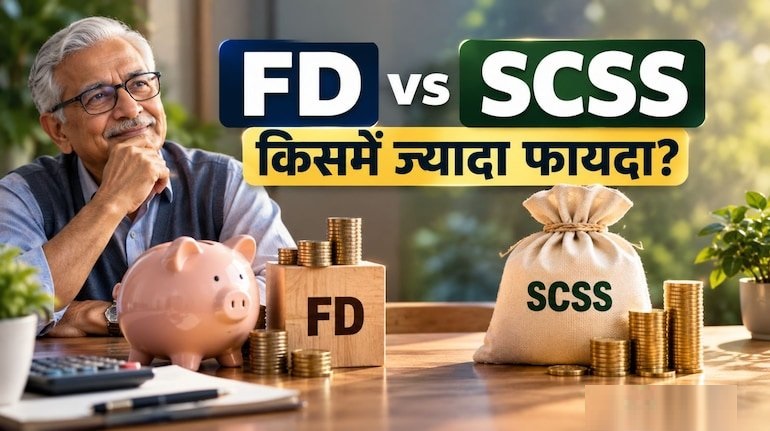
For senior citizens, security of their hard-earned money and the regular, risk-free income it provides after retirement is the biggest priority. Mainly two investment options are most popular among investors aged 60 years and above—first is Senior Citizen Fixed Deposit (Bank FD) of banks and second is the central government-backed Senior Citizen Savings Scheme (SCSS).
Although both the options guarantee capital protection and fixed returns, there are significant differences between the two schemes in terms of interest rates, payout frequency, maximum deposit limit and income tax rules. It is important for retired employees and senior citizens to understand which option will prove more beneficial as per their liquidity needs and tax bracket.
Senior Citizen Savings Scheme (SCSS) is a major small savings scheme operated through post offices and authorized government and private banks. Its interest rates are reviewed every quarter by the Central Government. Currently 8.2% annual interest rate is being given on SCSS.
The most special thing about this scheme is that its interest is deposited directly into the investor’s bank account every quarter (31 March, 30 June, 30 September and 31 December), thereby ensuring regular income like pension. The Central Government has increased the maximum investment limit in SCSS under single or joint account from Rs 15 lakh to Rs 30 lakh. The maturity period of this scheme is 5 years, which can be extended in blocks of three years after maturity.
Major government (like SBI, PNB) and private banks (like HDFC, ICICI) of the country offer additional interest rates to senior citizens over normal customers ranging from 0.50% (50 basis points) to 0.75% in certain tenures. Currently various banks are offering interest rates ranging from 7.25% to 7.75% (and 8.00% to 8.25% in some small finance banks) for senior citizens for tenures of 1 to 5 years.
The biggest advantage of bank FD is its flexibility of tenure. While in SCSS you have to mandatorily lock the money for 5 years, bank FD can be made for any period ranging from 7 days to 10 years. Additionally, investors in bank FDs can choose to withdraw interest as per their convenience—be it monthly, quarterly or in lump sum on maturity.
Let us see a comparative calculation of returns from both the schemes for an investment of Rs 15 lakh and a maximum of Rs 30 lakh for a period of 5 years:
| Parameters/Comparison | Senior Citizen Savings Scheme (SCSS) | Bank Senior Citizen FD (Avg. 7.50%) |
| current interest rate | 8.20% per annum | 7.50% per annum |
| Tenure | 5 year | 5 year |
| Method of interest payment | Quarterly | Quarterly/Monthly/On Maturity |
| Quarterly interest on ₹15 lakh | ₹30,750 | Approximately ₹28,125 |
| Total interest on ₹15 lakh for 5 years | ₹6,15,000 | ₹5,62,500 |
| Quarterly interest on ₹30 lakh | ₹61,500 | Approximately ₹56,250 |
| Total interest on ₹30 lakh for 5 years | ₹12,30,000 | ₹11,25,000 |
It is clear that at a maximum investment of Rs 30 lakh in 5 years, SCSS scheme is almost cheaper than bank FD. Rs 1,05,000 Provides additional interest returns of Rs.
Both schemes have their own advantages and limitations from a tax perspective:
-
Tax exemption at the time of investment (Section 80C): Investments made in SCSS are eligible for tax deduction of up to Rs 1.5 lakh per year under Section 80C of the Income Tax Act (under the old tax regime). The benefit of 80C is available only on 5-year ‘Tax Saver FD’ in the bank, not on ordinary FD.
-
Tax exemption on interest income (Section 80TTB): The interest received from both the schemes comes under the ambit of income tax for senior citizens. However, under Section 80TTB, senior citizens get a rebate of up to Rs 50,000 on the total interest earned from FDs and post office savings schemes in a financial year. Banks or post offices deduct TDS if interest exceeds Rs 50,000, which can be stopped by submitting Form 15H if the total taxable income is less than the basic exemption limit.
If your priority is to get maximum regular income (every 3 months) with secure government guarantee for 5 years, then first choice Senior Citizen Savings Scheme (SCSS) There should be. The secured interest rate of 8.2% is much higher than the 5-year FD rates of most conventional banks.
At the same time, if you need money for a short period like 1, 2 or 3 years, or you need to meet the expenses every month. Monthly Interest (Monthly Payout) want, then bank FD Proves to be more practical. It would be wise to keep some amount in a 1 to 2 year bank FD for emergency liquidity and invest the rest of the surplus capital in SCSS for 5 years for maximum returns.