 look news india

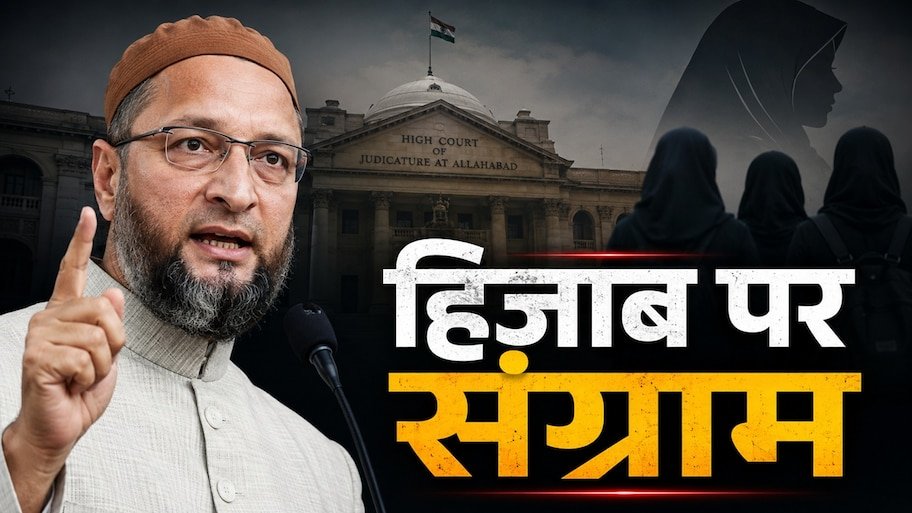
The political and legal debate regarding hijab and religious attire has once again intensified in the country after the Allahabad High Court rejected the petition of a student seeking permission to follow the dress code prescribed in an educational institution and wear hijab inside the classroom. All India Majlis-e-Ittehadul Muslimeen (AIMIM) chief and MP Asaduddin Owaisi has expressed a sharp reaction to this stance of the court and the restrictions of the institutions. Owaisi has termed it as a direct attack on the basic rights, education and religious freedom of Muslim girl students.
This case has once again brought the issue of balance between Article 25 of the Constitution (right to religious freedom) and discipline and mandatory dress code in educational institutions to the center of national discussion.
What was the stand and decision of Allahabad High Court?
The entire matter was related to a petition filed by a college student from Uttar Pradesh, in which she had sought permission to wear hijab in class in compliance with the dress code of the institute. While hearing the case, the Allahabad High Court bench clarified that educational institutions have full legal right to impose a prescribed uniform or dress code to maintain discipline, equality and uniformity.
The court in its judgment held that when a student takes admission in a recognized institution, he is bound by the established rules and discipline of the institution. The demand for mandatory imposition of any specific religious symbol or dress as an alternative to the regular uniform cannot be accepted. The court also underlined that the main objective of educational campuses is to create a sense of equality where there should not be any visible religious discrimination.
Asaduddin Owaisi’s sharp counterattack: ‘Attempt to stop the education of Muslim daughters’
Expressing strong objection to the High Court’s decision and the rules of the institute, AIMIM chief Asaduddin Owaisi said that wearing hijab is a personal choice, privacy and part of religious faith. He alleged that through such restrictions, an environment is being created to deprive Muslim girl students of higher education.
Owaisi said in his statement that the Constitution of India gives complete freedom to every citizen to wear clothes of their choice and practice their religion. Objecting only to hijab when symbols of other religions like turban, kada, sacred thread or tilak are accepted is discriminatory. He raised questions as to how covering the head could harm another student’s studies or the discipline of the college.
Constitutional provisions versus institutional discipline: What is the legal conflict?
The legal dispute over hijab revolves around two main constitutional arguments:
-
Article 25 and Article 21: The petitioners and supporters argue that hijab is an essential religious practice in Islam and Article 25 of the Constitution grants freedom of conscience. Besides, the right to privacy and personal choice is also protected under Article 21.
-
Autonomy of the Institute and Article 19(2): On the other hand, educational institutions and governments argue that reasonable restrictions can be imposed to maintain public order, decency and equality. The basic purpose of uniform is to make all the students look the same in the class.
From Karnataka to Supreme Court: This issue has arisen before too
This is not the first time that the hijab issue has reached the threshold of the court. Earlier, the hijab controversy that started from Udupi in Karnataka had reached the Karnataka High Court and then the Supreme Court. A division bench of two judges in the Supreme Court had given a split verdict on this, after which the matter is pending for consideration before the Larger Bench.
After the latest decision of the Allahabad High Court, legal experts believe that a permanent solution to such disputes will be possible only when the Constitution Bench of the Supreme Court presents a final and clear legal interpretation on it.