 look news india

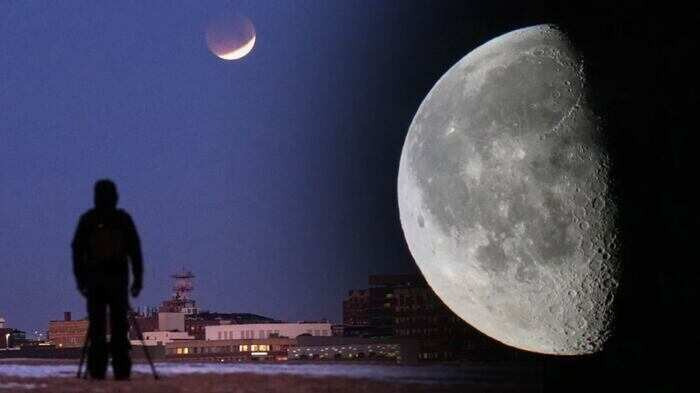
This week of the year 2026 is going to be very exciting and special for astronomy lovers, because a very rare and amazing astronomical event is going to happen in the sky. According to space science reports, during this week’s lunar eclipse (Chandra Grahan 2026), about 96 percent of the Moon will be hidden in the dense shadow of the Earth and it will appear in a completely new and copper-red form. There is tremendous enthusiasm among astronomers and stargazers around the world regarding this unique partial lunar eclipse. Since this event is related to the biggest and most attractive sighting of the moon of this year, everyone is desperate to know in which countries this celestial adventure will be visible and what effect it will have on the Indian subcontinent.
When and how will this partial lunar eclipse of 2026 occur?
According to astronomical calculations, this deep partial lunar eclipse is going to occur on August 28, 2026. During this time, when the Earth passes between the Sun and the Moon, more than 93 percent of the Earth’s main shadow (Umbra) covers a large part of the Moon. According to Indian time (IST), this eclipse will start with the penumbra touch at 6:53 am in the morning, while the main partial eclipse will start from 8:3 am in the morning and will continue till 11:21 pm. The peak and main attraction of this eclipse will be at 9.42 am, when about 96.2 percent of the Moon will be covered in the Earth’s dark shadow. Although this is not a total lunar eclipse, its scope will be so large that it will appear as spectacular and scary red in color as a total eclipse.
Will lunar eclipse be seen in India and what is the truth of Sutak period?
The biggest question that is arising in the minds of people across the country and especially those who follow the Sanatan tradition is whether this lunar eclipse will be visible in India? The clear answer is that this lunar eclipse will not be visible at all in India. According to astronomical time, when this event will occur, it will be morning time as per Indian time and in India the Moon will be below the horizon i.e. it will be day time. Since the moon will not be visible in India at the time of the eclipse, it will not have any geographical or religious impact in the country. This simply means that any type of ‘Sutak Kaal’ will not be valid in India during this period. On the same day, Raksha Bandhan, the festival of sacred love between brother and sister, is also being celebrated across the country, and due to the eclipse not being visible in India, it will not have any impact on the holy festival of Raksha Bandhan and all types of traditional rituals.
In which parts of the world will this amazing astronomical sight be seen?
This partial lunar eclipse may not be visible in India, but it will be visible with complete clarity in other large parts of the world. According to space science experts, this astronomical phenomenon will be visible with full grandeur in the areas of North America, South America, Western Europe, Western Africa and the Pacific Ocean at night or at the time of moon setting. People living in these areas will be able to enjoy this amazing sight with their naked eyes without any special glasses or safety equipment, as no solar filter is required to view the Moon or a lunar eclipse. From a scientific point of view, this is considered to be one of the longest and deepest partial lunar eclipses of the year.
The thrill of astronomical events and the growing scope of space science
The year 2026 has brought many big gifts one after the other for space lovers. Since the beginning of the year, many solar and lunar eclipses have taken place, and this lunar eclipse in the month of August is another important link in this series. Science experts say that such incidents not only provide an opportunity to understand the mysteries of the universe, but also create curiosity about space science in the general public. Even though Indian viewers may not get a chance to see this eclipse with their own eyes this time, this historic spectacle can definitely be seen online from other corners of the world through modern technology and live streaming.