 look news india

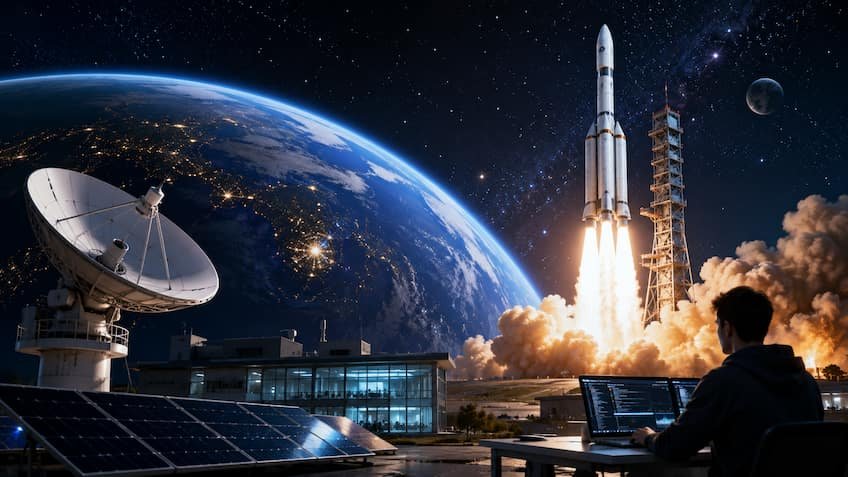
India’s space program, which started in 1962 with the vision of Dr. Homi Jahangir Bhabha and Dr. Vikram Sarabhai, has today, after a journey of six decades, established itself as the world’s most powerful and modern space ecosystem. This journey started today by carrying rocket parts on bicycle and bullock cart from Thumba, Kerala. 440 registered space startups And has taken the form of a huge space economy worth 9 billion dollars (USD 9 Billion). India’s space sector, which has emerged from government control and become the center of private participation and global innovation, is now taking historic steps towards manned mission ‘Gaganyaan’ and setting up its own ‘Indian Space Station’ (BAS).
From 1962 till now: The journey from Thumba’s sounding rocket to the South Pole of the Moon
The foundation of the Indian space program was laid in 1962 with the formation of the ‘Indian National Committee for Space Research’ (INCOSPAR). After this, the Indian Space Research Organization (ISRO) was established in 1969.
The successful launch of the first indigenous satellite ‘Aryabhatta’ in 1975 and the creation of reliable launch vehicles like INSAT, PSLV and LVM-3 made India the global hub of satellite launches. The discovery of water molecules on the Moon by Chandrayaan-1, the success of Mangalyaan in its historic first attempt and the historic soft landing of Chandrayaan-3 on the South Pole of the Moon on 23 August 2023 have brought India to the forefront of the world’s top space nations.
440 space startups and the historic revolution of the private sector
Following the historic reforms in the space sector and the formation of the Indian National Space Promotion and Authorization Center (IN-SPACe), there has been a flood of private companies and startups in the country.
-
Expansion of Startups: In the year 2014, there was only 1 space startup in the country, which today has increased to almost 440 startups Has reached.
-
Boom in private investment: Private investment in the private space sector has touched more than $600 million, aided by the liberalization of foreign direct investment (FDI) norms and a venture capital fund of ₹1,000 crore.
-
Private Rockets and Satellites: Indian startups like Agnikul Cosmos, Skyroot Aerospace, Pixel and Dhruv Space are now able to launch their own rockets and establish Earth Observation satellite constellations.
Latest update on Gaganyaan mission: India’s first human flight in space
India’s ambitious human spaceflight program ‘Gaganyaan’ The budget has been expanded to ₹20,193 crore. The main objective of this mission is to send 3 Indian astronauts (Gaganayatri) into 400 km low Earth orbit (LEO) for 3 days and land them back safely in the ocean.
Under the mission, in the first uncrewed experimental test, the female robot ‘Vyommitra’ (Vyommitra Half-Humanoid) will be sent into space so that the life support and safety systems of the crew module can be accurately tested. After this, in the upcoming phases, selected astronauts of the Indian Air Force will travel to space with the tricolor.
Indian Space Station (BAS): Country’s space lab to be established in orbit by 2035
India is on its way to becoming the fourth country in the world to operate its own space lab after Russia, America and China. Approved by Union Cabinet ‘Indian Space Station’ (BAS) There will be a state-of-the-art 5-module station weighing 52 tonnes, which will orbit the Earth at an altitude of 400-450 km.
-
First module (BAS-01): The first base module (BAS-01) of the Indian Space Station is targeted to be launched into space by the year 2028 through India’s most powerful rocket LVM3.
-
Full station operation: The entire 5 module station will be fully operational by the year 2035.
-
Microgravity Research: The station will provide an independent platform to Indian scientists and researchers for long-term human research in space medicine manufacturing, biological experiments, materials science and future Moon and Mars missions.
This space journey of India is not limited only to scientific achievements, but it is a strong and self-reliant blueprint for the country’s strategic sovereignty, communications, disaster management and taking the space economy to $ 45 billion in the next 10 years.