 look news india

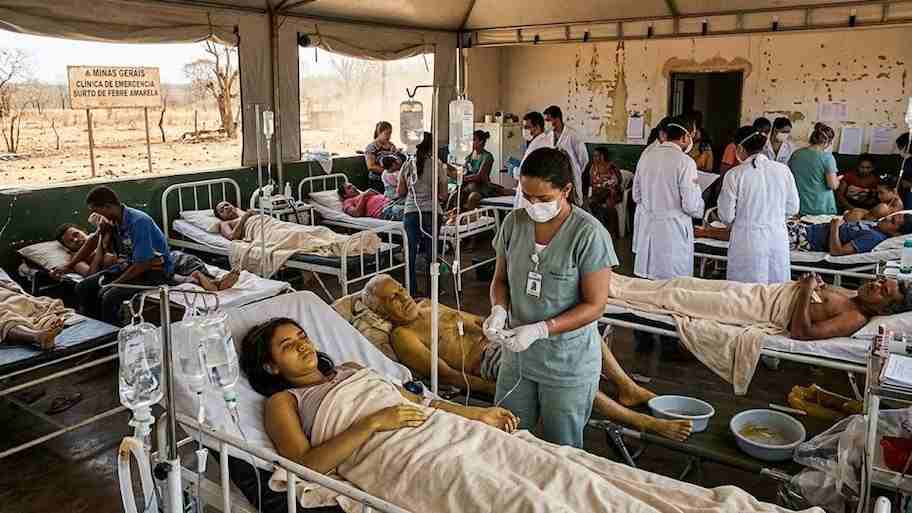
The Latin American country Brazil is currently facing a double whammy. On one hand, the country has witnessed the most horrific and devastating drought in the last 73 years, while on the other hand, the outbreak of deadly ‘Yellow Fever’, which emerged from the womb of this drought, has engulfed the densely populated cities. This dangerous viral infection, which is usually limited to the dense rainforests of the Amazon and Atlantic, is now spreading rapidly in metropolitan cities and residential colonies. The direct scientific connection between this virus that escaped from the forests to the cities and the worst drought in a century has raised concerns of virologists and epidemiologists around the world.
73 years of drought has devastated the Amazon and rivers.
According to Brazil’s national water and environment agencies, El Nino and record-high global temperatures have caused the country’s major rivers—the Amazon, Rio Negro and Madeira—to become historically dry. Many vast waterways turned into dry sand plains, which not only destroyed biodiversity but also created a serious drinking water crisis for millions of people. Due to this historic drought, the natural ecosystem of the forests completely collapsed, which forced the wildlife and insects to leave their natural habitats and flee towards human settlements in order to survive.
How did the dreaded virus reach cities from forests?
Yellow fever virus usually circulates in a ‘sylvatic’ (wild) cycle, where mosquitoes of the Haemagogus and Sabethes species, which live mainly in the upper parts of trees, spread it by biting monkeys. Due to extreme drought, when forest water sources dried up and tree canopies began to collapse, infected monkeys and mosquitoes crossed forest boundaries into agricultural areas and urban peripheries in search of food and water. Here the virus encountered urban mosquitoes—particularly Aedes aegypti, which are also notorious for spreading dengue and Zika. As soon as Aedes mosquitoes started biting infected humans, the disease turned into the ‘urban yellow fever cycle’ and started spreading like gunpowder in settlements.
Water crisis and compulsion to store water became a problem
The drought has left taps dry in cities, forcing people to store water in buckets, drums and open tanks for weeks. Due to not being properly covered, these domestic water sources became suitable breeding grounds for Aedes aegypti mosquitoes. Due to extreme heat, the life cycle of mosquitoes accelerated and the incubation period of the virus within them also decreased. As a result, the disease which was thought to be limited to dense forests, reached the courtyard of every house.
Symptoms and life-threatening complications of yellow fever
Yellow fever is an acute hemorrhagic disease caused by a flavivirus. In the initial stage of infection, the patient complains of sudden high fever, unbearable pain in the muscles, back pain, headache, tremors, loss of appetite and nausea. In about 15 to 20 percent of the cases, the disease enters the ‘toxic phase’ within a few days. In this serious condition, the patient’s liver and kidneys start getting damaged rapidly. Liver damage causes the skin and eyes to turn yellow (hence the name ‘yellow’ fever), internal bleeding from the mouth, nose, eyes or stomach, and dark blood in the patient’s vomit. If proper treatment and monitoring is not received on time, the mortality rate in patients with severe stage can reach up to 50 percent.
Epidemiologists’ warning and global concern
Experts from the World Health Organization (WHO) and the Pan American Health Organization (PAHO) say the Brazilian crisis is living proof of how climate change is changing the geography of the spread of deadly diseases. Scientists have warned that if the pace of drought and deforestation continues, other countries in tropical regions may also become vulnerable to such ‘viral spillovers’. The Brazilian government has ordered mass yellow fever vaccination drives, pesticide spraying and emergency water supplies in affected areas to prevent the virus from spreading across South America.