 look news india

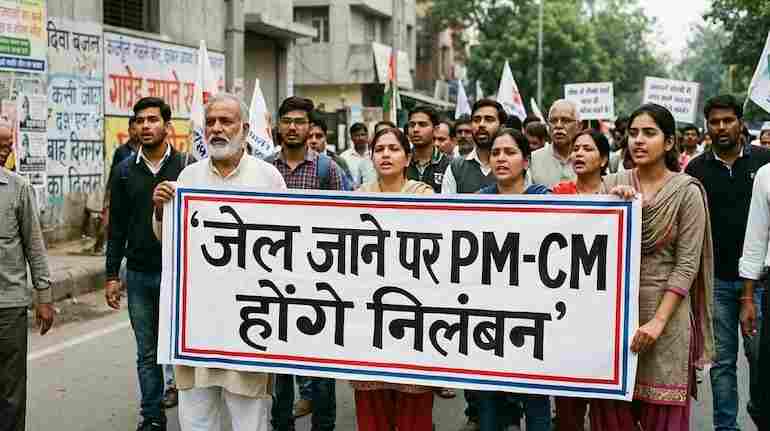
130th Constitutional Amendment Bill: Preparations are underway for a major and historic change in Indian politics and constitutional system. Amid strong opposition and concerns from opposition parties, a Joint Parliamentary Committee of Parliament reviewing the 130th Constitutional Amendment Bill has submitted very important recommendations.
The committee has proposed that if the country’s Prime Minister (PM), Union Ministers or Chief Ministers (CM) of states are detained or kept in jail for 30 consecutive days in a serious criminal case, they should be suspended instead of permanently removed from their posts.. Along with this, the committee has also suggested adding an ‘automatic reversal clause’ for the safety of the leaders.
What was the original bill and why was there opposition?
The main objective of this original bill, introduced in Parliament by the Central Government in August last year, was to ensure that no government could be run from inside the jail.
-
Basic Provisions: If any PM, CM or Minister remains in custody for 30 days for a serious crime and does not resign himself, then on the 31st day he will be automatically dismissed from the post.
-
Opposition’s stance: Most of the opposition parties of the country including Congress had strongly opposed this law. His allegation was that the central government could misuse this law and conspire to destabilize the state governments ruled by opposition parties. Due to this protest, most of the opposition parties had also distanced themselves from the meetings of the joint committee reviewing this bill.
5 most important recommendations of the parliamentary committee
To address the opposition’s apprehensions and make the law more practical, the Joint Committee has recommended two special and three general amendments:
-
The word ‘suspension’ instead of ‘removal’: In its report, the committee has proposed to change the word ‘Removal’ to ‘Suspension’. That is, until the final result (decision) of the legal proceedings comes, the ministers should only be kept suspended instead of being dismissed permanently.
-
‘Serious offences’ punishable with imprisonment of 5 years or more: To prevent misuse of this law, the committee has clearly defined ‘serious crimes’. Under this, only those crimes will be included in which imprisonment of 5 years or more There should be a provision for punishment. For this, it has been said to add a separate schedule in the law.
-
Automatic Reversal Clause: If the accused minister is completely acquitted by the court, or the investigating agency fails to proceed with the case within the stipulated time limit, his suspension will automatically end and he will be able to return to his post. The committee says that this security measure will ensure that the suspension of people who are innocent does not become permanent.
-
Speedy trial in special courts: Citing the old guidelines of the Supreme Court, the committee said that the cases related to persons holding high constitutional posts should be heard on priority basis in fast track or special courts, so that milk can be converted into milk and water from water.
Now what will be the next process?
There is every possibility that this report of the Joint Committee of Parliament will be officially approved this week. If these recommendations are accepted, the subsequent process will be as follows:
-
Cabinet approval: The Union Ministry of Home Affairs will send the draft of these proposed amendments to the Union Cabinet for final approval.
-
Appearance in Parliament: After getting the green signal from the Cabinet, this revised outline bill will be introduced again in the Lok Sabha and Rajya Sabha for official passage.