look news india

Ghee has a very special place in Indian cuisine. Whether you want to add tempering to dal, spread it on hot rotis or make delicious sweets, every taste seems incomplete without ghee. Pure desi ghee not only enhances the taste of food, but the good fats present in it also strengthen our health, immune system and bones. This is the reason why a box of ghee will definitely be found in the kitchen of every Indian house.
But, in today’s times, despite it being so important for health, many people have started shying away from eating ghee. The biggest reason for this is the increasing adulteration in ghee available in the market. Fake ghee mixed to earn a few rupees profit is making the body seriously ill instead of improving health. In such a situation, the country’s top food safety organization FSSAI (Food Safety and Standards Authority of India) To make consumers aware, has shared some very effective tips to check the purity of ghee at home.
What is adulterated ghee and what dangerous things are added to it?
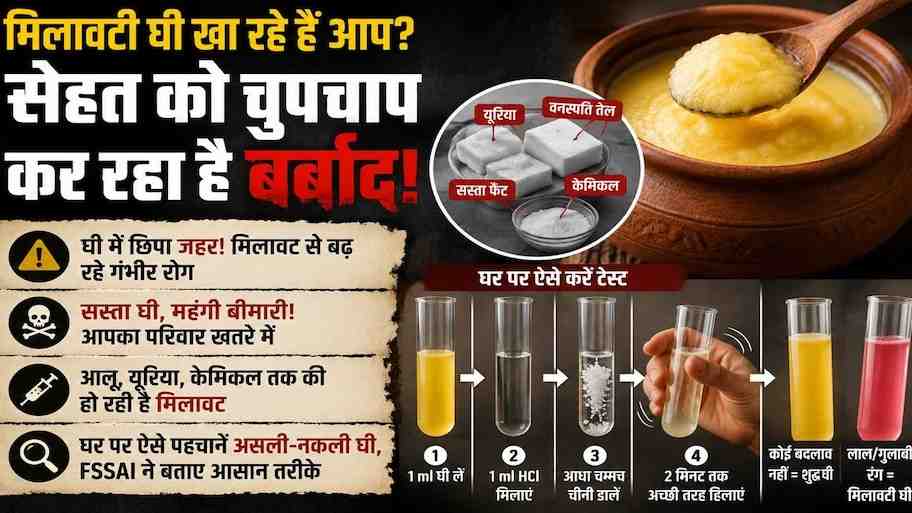
Mafias use very poor and health injurious methods to prepare adulterated or fake ghee. To increase the quantity and weight of ghee, mainly the following things are added to it:
-
Cheap Oil and Dalda (Vegetable): Hydrogenated edible fat or vegetable ghee is most often mixed with real ghee.
-
Starch and Boiled Potatoes: To give ghee a thick and grainy texture, mashed boiled potatoes or sweet potatoes are added to it.
-
Chemical and Artificial Fresheners: To bring the original fragrance and yellowness in fake ghee, dangerous chemicals like banned fresheners, sweeteners and urea are used, which cause direct harm to the liver and kidneys.
FSSAI’s ‘Sugar Test’: How to identify real and fake ghee in minutes at home
FSSAI has released a video on its official social media handle (X) stating that you can find out in a very easy scientific way in your home kitchen whether your ghee is adulterated with Vanaspati or Dalda or not. The step-by-step method of performing this test is given below:
-
First of all, take a clean glass test tube or a small transparent glass and put 1 ml melted ghee Enter.
-
Now add equal quantity of this melted ghee i.e. 1 ml Concentrated Hydrochloric Acid (HCl) Mix.
-
After this in this mixture Half teaspoon table sugar (common ground sugar used at home) Enter.
-
Now close the mouth of the test tube safely and bring the entire mixture to a minimum. Shake very well for two minutes..
-
After stirring, leave the mixture absolutely still for about 5 minutes so that the layers of acid and ghee can separate.
Result:
-
If the ghee is completely pure: So there will be no change in the color of ghee or acid, it will remain in its natural color.
-
If ghee is adulterated: If vegetable, dal or bad fat has been mixed in ghee, then the color of the lower layer containing acid will change. Red or Pink Will be done.
Take special care while doing chemical test
FSSAI has clarified that since this test uses hydrochloric acid (HCl), which is a very strong and flammable acid, extreme caution should be taken while doing it.
To ensure that acid drops do not fall on your skin or eyes, wear gloves while doing the test. If you feel uncomfortable doing this test at home, you can also send a sample of ghee to your nearest government or FSSAI certified national lab and get its purity tested authentically. Don’t compromise on health; Stay informed, stay safe!