 look news india

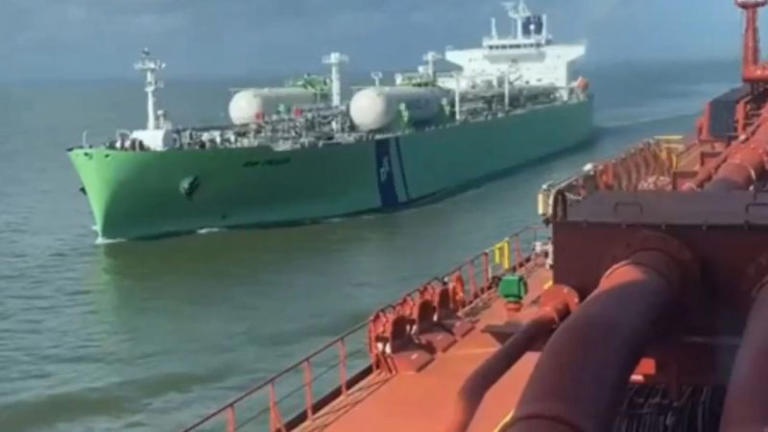
A very big, historic and relief news is coming out for India from the battlefield and diplomatic corridors of West Asia. Within just a few hours of the much-awaited peace deal between US President Donald Trump and Iran, the ice of tension in the world’s most dangerous and sensitive sea route ‘Strait of Hormuz’ has started melting rapidly.
After the official announcement of this global agreement, the world’s first commercial merchant ship to safely cross this largest and strategic ‘Chokepoint’ of the sea has become none other than India’s giant LNG tanker ‘Disha’.
The most surprising and proud thing is that for the last several weeks, cargo ships from all over the world were passing through this sea route in complete fear, hiding and turning off their transponders (location signals) to avoid international tracking; At the same time, the ship ‘Disha’ equipped with Indian crew kept its Automatic Identification System (AIS) on immediately following the international strict protocol. The ship passed safely in front of the Iranian Navy without any damage while continuously sending its live location to satellites.
‘Disha’ will reach Gujarat on June 18 with huge treasure of gas from Qatar.
Director of the Union Shipping Ministry, Opesh Kumar Sharma has officially confirmed this major naval and commercial success of India. Operated by ‘Shipping Corporation of India’ (SCI), a Navratna company of the Government of India and bearing the flag of Malta, this huge ship was kept stuck off the coast of Qatar for the last three months due to the fierce war raging in the Persian Gulf.
-
Great treasure of gas: LNG carrier ‘Disha’ with itself 62,370 metric tons of Liquefied Natural Gas (LNG) He is bringing a huge and precious treasure.
-
Anchoring in Gujarat: This gas tanker loaded from the port of Qatar has successfully crossed the maze of the Strait of Hormuz and will reach the port in the coming days. 18 June 2026 of Gujarat Dahej Port Will anchor at. With the influx of this gas, the ongoing shortage of natural gas in the domestic and industrial markets of the country will be immediately removed. This is the first Indian merchant vessel to cross this dangerous route amid the fierce fighting of the last two months.
The journey was like ‘Agnipariksha’: Remembered that dreadful scene of 18th April
Crossing this narrow sea route was no less than a big ordeal for the ship ‘Disha’ and its captain. Due to India’s strong diplomatic efforts, some ships did leave the Gulf in March and early April, but 18 April There was an outcry on this waterway when the Iranian Navy (IRGC) suddenly completely closed the Strait of Hormuz and fired rockets and machine guns directly at some Indian ships trying to forcibly pass through there.
Just one lucky Indian ship on that dreadful day ‘Desh Garima’ Using his wisdom, he managed to escape into the deep sea to save his life. In response to this attack, America also imposed a strict naval blockade of Iranian ports, due to which the situation went from bad to worse. The wheels of foreign ships carrying oil and gas worth billions of dollars for India stopped there and from then till now no Indian flagged ship was able to muster the courage to enter this maze.
Why is the Strait of Hormuz considered a ‘lifeline’ for India?
past 28 February Since the beginning of the direct war in the Middle East, Iran had brought the entire world’s economy to its knees by blockade of the Strait of Hormuz, because before the war, the entire world was 20% oil and gas trade Had to go through this narrow path alone. Its closure triggered global fuel shortages and inflation. From India’s point of view, this route is the lifeline of the country’s economic sovereignty, which can be easily understood from these three big figures:
-
90% LPG(LPG): India imports 90% of the total LPG (cooking gas) requirement to keep its domestic kitchens running through this Hormuz route and from the countries of West Asia. This is the reason why when the crisis deepened, the Central Government first gave top priority to the safe evacuation of its 8 LPG tankers.
-
60%LNG(Natural Gas): 60% of the LNG (natural gas) that supplies electricity to the country’s big factories, fertilizer plants and power stations is also imported through this strait, which has now been restored by the ‘Disha’ ship coming from Qatar.
-
40% Crude Oil: Crude oil, the main source of fuel for the vehicles and industries running on the country’s roads, also reaches the refinery ports of India through this route. It is clear that even the slightest military movement on this route directly affects the budget of Indian cooks and jams the wheels of roads and factories.
13 Indian ships are still captured in the Persian Gulf; keeping pace with each other
The Indian Navy and shipping companies have certainly heaved a sigh of relief with the safe exit of the LNG tanker ‘Disha’, but 13 Indian commercial cargo ships and thousands of their Indian sailors are still stranded in various ports of the Persian Gulf and the Gulf of Oman. From the beginning of March to mid-June, only 10 Indian ships have managed to cross this route safely.
Shipping corporation and maritime security experts say that even though the US-Iran historic diplomatic deal has been announced by the White House and the final documents of the agreement are going to be signed by both the countries this week, global shipping and insurance companies are still stepping in full swing. It may take several weeks for ship traffic to completely normalize as international companies want to see whether Iran fully adheres to the terms of the peace deal after the bitter and violent experiences of the last 3 months. The Ministry of Shipping, Government of India has clarified that as soon as this route is declared a completely ‘safe corridor’ by the international navies, all the remaining 13 ships stranded in the Gulf will also be immediately rescued and brought home with the cooperation of the Indian Navy.