 look news india

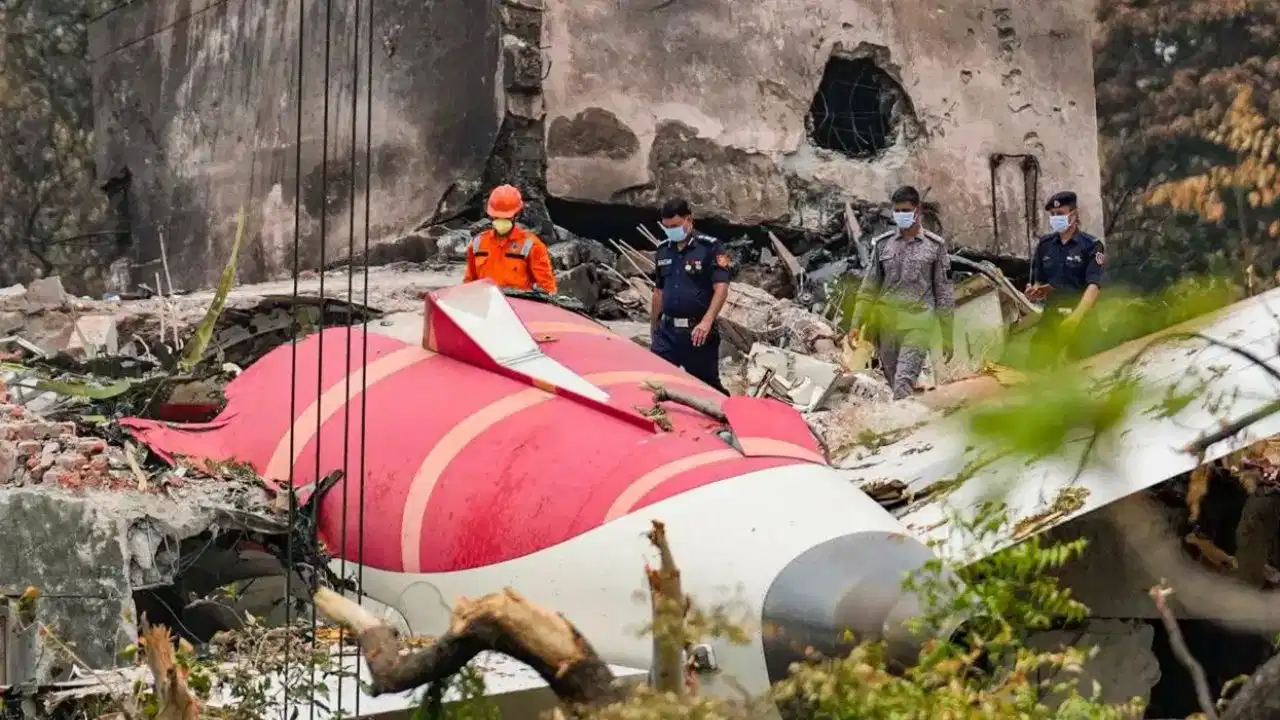
Exactly one year ago today, 12 June 2025 On a scorching afternoon, a tragedy occurred at Sardar Vallabhbhai Patel International Airport in Ahmedabad which shook the entire world. Air India flight AI-171 (Boeing 787 Dreamliner) took off for London’s Gatwick Airport with a total of 242 people on board. But just 32 seconds after takeoff, something mysterious happened in the air that the plane fell straight down.
There is a very strict international regulation of the aviation industry, which ICAO Annex-13 It is said. According to this rule, it is mandatory for the final black box investigation report to be revealed to the world within exactly 12 months of any major plane crash. Today, a full year has passed since this accident, but the final report is still not known. After all, what corporate pressure is working behind this delay? Let us understand this entire incident with straight facts without any twists.
That last journey of Flight 171: Timeline and statistics
There were 230 passengers on board that afternoon, including 161 Indians and 53 British nationals. The highly experienced Captain Sumeet Sabharwal and First Officer Clive Kunder were present in the cockpit. Everything was normal, but just 32 seconds after lift-off, the Dreamliner crashed into the hostel block of BJ Medical College, Ahmedabad.
It was clear from the CCTV footage that there was no explosion from outside the plane. The plane took off, but suddenly instead of increasing its height, it hung in the air and gliding and fell straight down.
The biggest suspense of cockpit voice recorder
The Aviation Accident Investigation Bureau (AAIB) released its preliminary report in July 2025, a month after the accident. This report gave birth to a new and terrifying theory. The data showed that both engines of the aircraft failed immediately after takeoff. fuel control switches (which are usually meant to start or stop engines on the ground) had suddenly moved from the ‘run’ position to the ‘cutoff’ position. That means the fuel supply to the engines was cut off in the air itself.
An even more sensational revelation came from the Cockpit Voice Recorder (CVR), which recorded conversations between the pilots:
Last words from inside the cockpit
First Pilot: “Why did you cut off the fuel supply?”
Second pilot: “I didn’t do that at all!”
(The plane crashes the very next moment)
Based on this conversation, international media houses like ‘Newsweek’ and ‘The Wall Street Journal’ immediately started running the narrative that perhaps the pilot had deliberately taken this suicidal step. American experts also immediately gave a statement that this was not a malfunction of the plane, but the handiwork of a human being inside the cockpit.
Rescue of pilots and theory of system failure
Is this truth really as simple as it is made out to be? Organization representing about 6 thousand pilots of India Federation of Indian Pilots (FIP) Has described this initial report as completely biased. Federation President Captain CS Randhawa clearly said that when a pilot dies, the entire blame is often put on the dead pilot in order to save the manufacturer company of the aircraft.
Captain Sumeet’s 91-year-old father Pushkar Raj Sabharwal approached the Supreme Court of India against this one-sided theory. Considering the sensitivity of the matter, the Supreme Court also directed that the flight crew cannot be made a scapegoat before the investigation is completed.
American whistleblower organization ‘Foundation for Aviation Safety’ Ed Pearson, head of Boeing, presented documentary evidence rejecting Boeing’s theory. He claimed that the particular Dreamliner (VT-ANB) that met with the accident had a very poor past electrical track record.
So did a technical fault itself stop both the engines?
According to investigative journalists and aviation engineers, this aircraft ‘core network’ (The aircraft’s central nervous system) already had a technical fault before takeoff.
-
Software fallacy: A stronger theory says that just after takeoff there was a major electrical failure in the plane’s main computer, causing the systems to reboot. This reboot caused the plane’s software to give the illusion for a few seconds that the plane was still on the ground, even though it was in the air. The system considered the high thrust as a fault and generated an automatic command to automatically cut off the fuel supply to both the engines. That means the pilots did not even touch those buttons.
-
Opening of Ram Air Turbine (RAT): The biggest proof of this is the opening of the aircraft’s ‘Rat’ propeller, which opens automatically due to air pressure to provide emergency power to the aircraft in case of main power failure. CCTV footage showed that the rat had opened immediately after takeoff. Air India’s simulator tests show that this rat takes 14 to 18 seconds to become fully active. This clearly means that the malfunction in the aircraft had started long before the fuel switch was closed, probably while it was running on the runway.
Walkway to Life: The Miraculous Story of the Sole Survivor
In this horrific plane crash, there was one person who came out alive from the jaws of death. 40 year old British citizen Vishwas Kumar Ramesh window seat number that day 11A Were sitting on. As soon as the plane hit the building of BJ Medical College, there was a massive explosion in the central fuel tank present in its wings.
But as luck would have it, at that very second of impact the main structure of the aircraft completely split right in front of the cockpit and row 11. This structural split protected seat number 11A from the direct pressure of the catastrophic collision which crushed the front seats. The broken wall of the cabin stopped the fireballs from reaching them for a few moments. Without wasting any time, Vishwas jumped out of the way of the torn debris.
But the price of this miracle was very heavy. His younger brother Ajay Kumar Ramesh, who was sitting right next to him on seat 11J, was killed in this accident. Today Vishwas Kumar Ramesh is battling this severe mental trauma and survivor’s guilt in Leicester, England. His UK based lawyer Rad Seager is now waging a major legal battle against Air India and Boeing in international courts.
Compensation disputes and internal differences
How complicated this investigation has become can be gauged from the fact that the most senior expert of AAIB’s Flight Operations Group and a veteran Boeing 787 pilot. Captain RS Sandhu Has stopped attending investigation meetings since January this year. According to insiders, he had serious differences with other officials over the transparency of the investigation and distortion of facts.
On the other hand, Air India is providing an additional cash compensation of Rs 10 to 20 lakh to the families of the victims. ‘Indemnity Clause’ Getting it signed. The condition of this clause is that if the family takes this money, then it cannot sue Air India or Boeing in the international courts of America or Britain in future.
The lawyers of the victims’ families have called this an intimidating tactic of Air India, because Montreal Convention 1999 Under this, if the technical fault of the aircraft is proved, the financial liability of the airline becomes unlimited and it will have to pay compensation worth crores to the victims. Corporate houses may lobby to save their reputation, but the cries of the families left behind of the 260 lives that were destroyed that afternoon are still waiting for fair justice.