 look news india

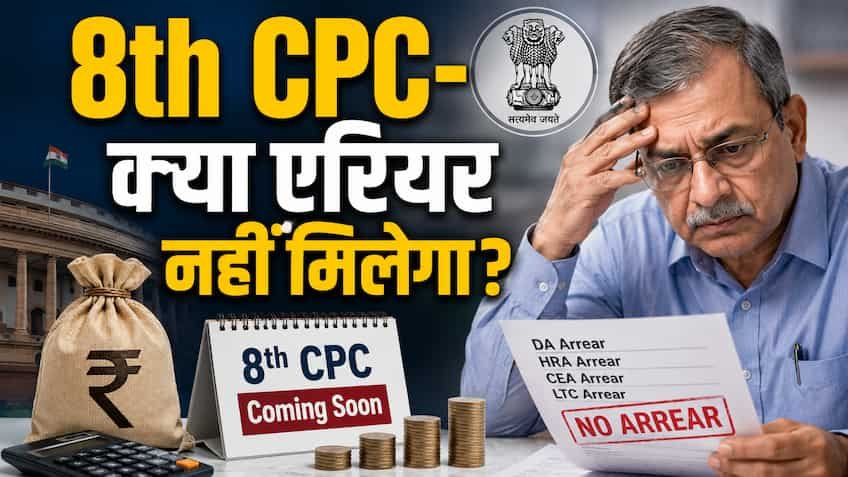
Discussions are intense among central employees and pensioners regarding the formation, recommendations and implementation of the 8th Central Pay Commission. With the implementation of every pay commission, the biggest hope of the employees rests on the revised salary and huge arrears received from the previous date. However, if we look deeply into the history of pay commissions and financial rules, employees may feel disappointed in the matter of arrears of allowances. As per the rules, when the new pay commission comes into effect, employees get retrospective arrears only of basic pay and pension, while no arrears are paid on major allowances like Dearness Allowance (DA), House Rent Allowance (HRA), Children’s Education Allowance (CEA) and Leave Travel Concession (LTC).
System of Pay Commissions: Basic Pay vs. Application of Allowances
The government follows two different formulas while implementing the Central Pay Commission recommendations:
-
Retrospective arrangement on basic pay and pension: Revision of basic pay and pension is usually implemented from the date previous to the effective date of the commission. No matter how much time it takes for the Commission’s recommendations to be approved by the Cabinet, the entire amount of difference in basic pay from the fixed effective date till the issue of notification is given to the employees in lump sum as arrears.
-
Prospective arrangement on allowances: In the case of allowances the rule is completely opposite. The Central Government always implements new rates related to allowances with prospective effect. This simply means that the revised allowances start being received from the same date or month on which the government issues the official gazette notification regarding them. Therefore, no arrears of enhanced HRA, CEA or other allowances arise for the period before the notification.
Example of 7th Pay Commission: Why arrears of allowances were not received
This rule can be easily understood with the example of 7th Pay Commission. The 7th Pay Commission was made effective from 1 January 2016 and arrears of revised basic pay were given to the employees from 1 January 2016 itself. But when it came to House Rent Allowance (HRA) and 196 other allowances, the government had constituted a ‘Committee on Allowances’ under the chairmanship of the then Finance Secretary Ashok Lavasa to examine them.
After the report of that committee and the final approval of the Cabinet, the revised allowances were implemented from 1 July 2017. As a result, central employees did not receive any arrears of enhanced HRA, transport allowance or CEA for the period of 18 months from January 2016 to June 2017. The same established tradition and rules are likely to be repeated in the 8th Pay Commission also.
DA reset to 0%: Mathematics of non-receipt of arrears
There is often confusion in the minds of employees regarding Dearness Allowance. Whenever a new pay commission comes into force, the cumulative dearness allowance received till that time is completely merged into the basic pay.
-
Adjustment of Fitment Factor: A new ‘fitment factor’ is decided by adding the then current DA and inflation, on the basis of which the new pay matrix is prepared.
-
New beginning from zero: The DA level is reset to zero (0%) once the new pay structure comes into effect. After this, DA starts getting added every 6 months afresh at the rate of 2%, 3% or 4% on the new basic pay based on the All India Consumer Price Index (AICPI-IW) data. Since the old DA has already become a part of the new basic pay, no separate arrears are payable in the name of DA.
What will be the direct impact on HRA, CEA and LTC?
-
House Rent Allowance (HRA): HRA available as per X, Y and Z category cities continues to be available at the old rates until the government officially notifies the new HRA slab. After notification, it is applicable on the new basic salary, but there is no differential arrears for the previous dates.
-
Children Education Allowance (CEA) and Hostel Subsidy: The fixed allowance received for children’s education also increases from the day the new rules come into effect; its claim cannot be revised for previous academic sessions.
-
Leave Travel Concession (LTC) and TA/DA: The rates of traveling allowances and daily allowances are applicable from the date of notification. Reimbursement claims under the new commission on old journey bills are not accepted.
Government strategy of budget and financial management
The main reason behind not giving retrospective arrears on allowances by the government is fiscal deficit and maintaining financial balance. Giving arrears of 12 to 24 months of basic pay as well as all allowances to lakhs of employees and pensioners simultaneously can put a huge financial burden on the government exchequer. Therefore, separate time is taken for review of allowances and they are activated from the date of receipt of financial approval.