 look news india

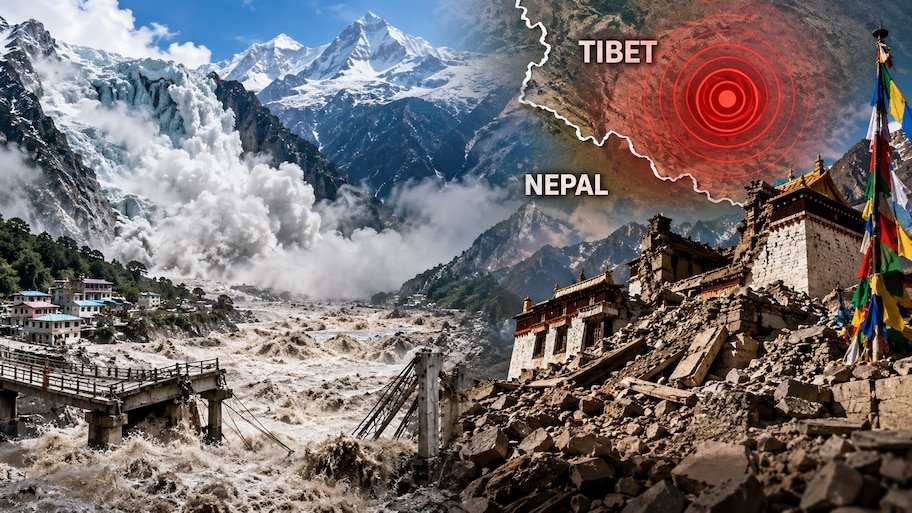
Another major crisis has hit the Himalayan region which is facing the fierce wrath of nature. Not even two weeks had passed since the massive devastation caused by devastating floods, rock slides and breaking of glaciers on the Tibetan border controlled by Nepal and China, when late on Tuesday night a massive earthquake shook the entire mountainous region. A powerful earthquake measuring 5.3 on the Richter scale was recorded in the Tibet-Nepal border region, according to the European-Mediterranean Seismological Center (EMSC) and local seismological centres. On Tuesday night, around 9:38 to 9:53 pm, when people were preparing to sleep in their homes, suddenly the ground started shaking and seeing the fans and equipment in tall buildings shaking, people started running towards the open fields screaming.
According to preliminary scientific data from earthquake monitoring stations, the epicenter of this earthquake was located near Lomanthang in Mustang district of north-western Nepal and the adjacent Tibet border area. This area falls about 375 kilometers north-west of the capital Kathmandu. European agency EMSC said that the hypocenter (central point) of the earthquake was at a depth of about 35 kilometers from the surface. India’s National Center for Seismology (NCS) also confirmed this seismic shock and recorded its intensity and depth as 5.0. Although there was no immediate official information about any major loss of life, property or building collapse due to this latest earthquake, but in many remote residential areas of Nepal including Manang, Dolpa, Myagdi and Kathmandu Valley of Nepal, the tremors were so strong that fear of disaster again spread among the people.
This earthquake has come at a very sensitive time when Nepal and Tibet are already facing the brunt of one of the worst natural disasters of the century. On August 26, the collapse of huge glaciers and icy rocks in the high Himalayan region (Ice-rock avalanche) caused deluge in the Bhotekoshi river and its tributary streams. This devastating flood had washed away hundreds of villages, pucca houses, roads, vehicles and major bridges in its path like straw. According to the latest report from Nepal’s National Disaster Risk Reduction Authority (NDRRMA), 1,357 bodies have been recovered so far in Nepal, while 5,326 people are still missing. On the other hand, 43 people have been confirmed dead and more than 500 people are missing inside Tibet on the Chinese border, due to which the total number of deaths in both the countries has crossed 1,400.
Relief and rescue operations in disaster-stricken areas are already going on in extremely harsh geographical conditions. At least 11 major hydropower projects have been destroyed due to floods and debris and more than 120 engineers and laborers are trapped in their underground tunnels, to rescue whom the army and rescue teams are digging day and night with machines. Meanwhile, the continuous seismic tremors have increased the concern of the rescue teams manifold. This is the second earthquake above magnitude 5 in Tibet and the Himalayan border within the last one week. Geologists say that even mild earthquakes can trigger new large-scale landslides on mountain slopes that are already wet and weakened due to heavy rains and floods, posing a serious threat of blockage of rivers and formation of artificial lakes.
The Chinese Academy of Sciences (CAS) and global climate scientists have warned that the entire Qinghai-Tibet Plateau and the Himalayan belt are currently undergoing a highly sensitive geological and environmental crisis. According to studies by scientists, due to global warming and rapid increase in temperature, about 24% to 40% of the glaciers in this region have melted and shrunk in the last six decades. Out of about 33,000 glaciers in Tibet, 187 glaciers are in very dangerous condition, their bursting or sliding is being monitored round the clock by satellite. Frequent earthquakes and uncontrolled climatic changes arising from the mutual friction of tectonic plates are raising a major alarm for the entire Himalayan and South Asian region.