 look news india

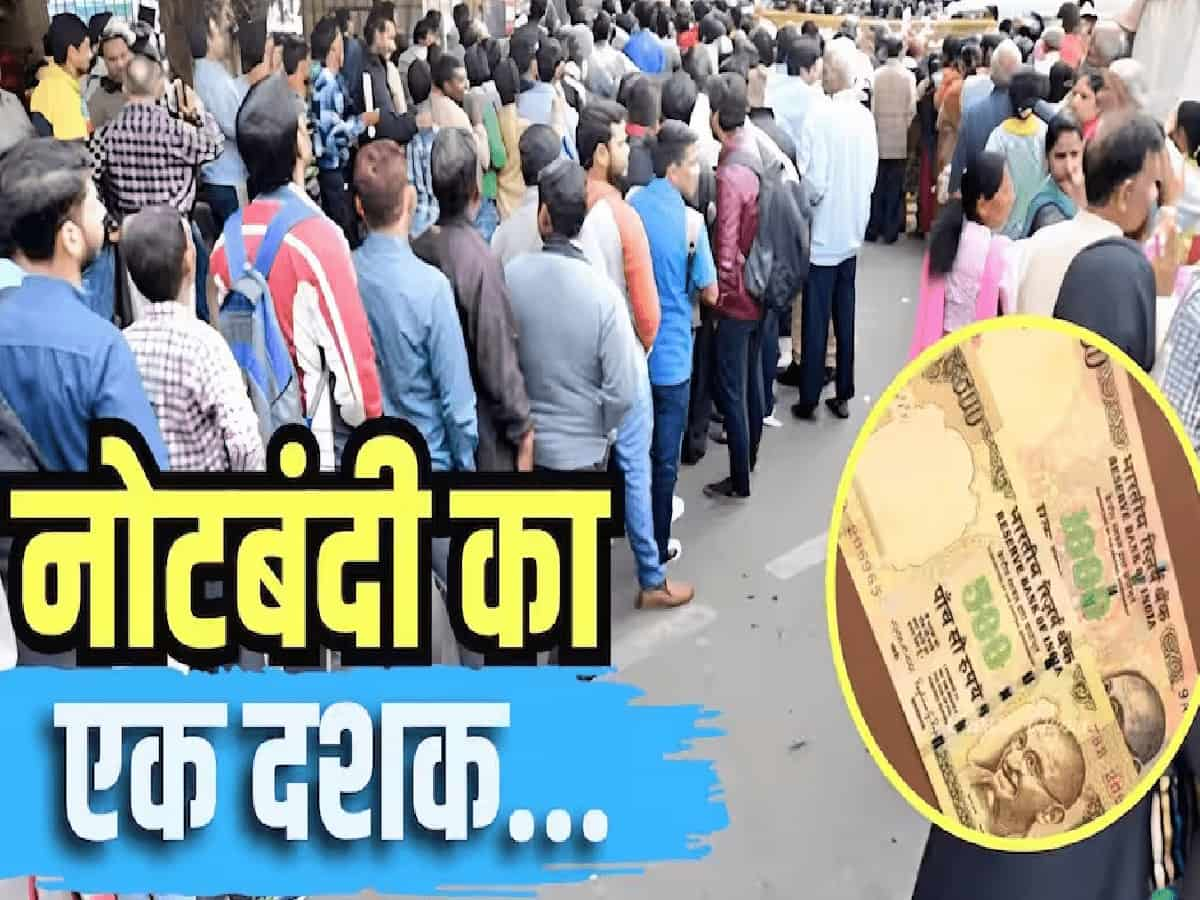
The date of 8 November 2016 has been recorded forever in Indian economic history. Today, a full decade i.e. 10 years has passed since that historic and bold decision. Exactly 10 years ago, at around eight o’clock in the evening, Prime Minister Narendra Modi had announced in a special televised address to the nation that from midnight on that day, the existing currency notes of Rs 500 and Rs 1000 running in the country would become legally invalid (not Legal Tender). This single announcement created an economic earthquake in the entire country. For the 130 crore citizens of the country, this was a decision which no one had even imagined. Transactions in the market suddenly came to a halt, there was chaos in marriage ceremonies and people started running towards ATMs and banks for daily needs.
In his address, the Prime Minister had appealed to the countrymen that those who have old notes of Rs 500 and Rs 1000 can go to their nearest bank branches or post offices from November 10, 2016 to December 30, 2016 i.e. within about 50 days and get these notes deposited in their accounts or get them exchanged in limited quantities. After this, the period of long queues outside banks and ATM machines started, which continued continuously for almost two months amidst the bitter cold. Considering the size of the country’s economy, about 86 percent of the total currency in circulation at that time was in the form of Rs 500 and Rs 1000 notes. According to the data, at that time a total of Rs 15.44 lakh crore worth of currency was circulating in the market, out of which about Rs 13.27 lakh crore of high notes were converted into waste papers overnight.
One of the main stated objectives of the demonetisation decision was to break the financial backbone of black money, counterfeit currency networks and terrorism. However, when the Reserve Bank of India (RBI) released its final official report after this entire exercise, the figures were extremely shocking and gave rise to debate. According to the latest RBI data, about 99.3 per cent of the total Rs 15.44 lakh crore notes that were banned were deposited back into the official banking system. That means there were only 0.7 percent notes which did not reach the banks. Critics saw it in the sense that those holding black money also converted their money into white through banking channels in some way or the other.
But another point of view from economists and financial experts also emerged. The government and the central bank argued that the biggest success of demonetization was the return of 99.3 percent of the currency into the banking system. This simply meant that the entire money which was till now buried in home safes, under mattresses or in the informal cash economy (Shadow Economy) and on which the government was not getting any tax, came under the radar of the formal banking system. The information of every depositor, his PAN number and bank account data was registered with the Income Tax Department, which made the entire financial structure of India transparent forever.
In this 10-year journey of demonetization, the most profound and lasting impact on the Indian fiscal system was seen on direct tax collections. The number of individual and corporate taxpayers filing income tax returns (ITR) has witnessed an unprecedented growth of more than double in the decade following demonetization. Traders and businessmen who earlier used to hide their real income only through cash transactions, had to face notices and investigations from the tax department after depositing huge amounts of cash in banks. As a result, the culture of tax compliance developed rapidly.
This massive inflow of money into banking channels tremendously strengthened the tax base of the central and state governments. This system, combined with advance tax, self-assessment tax and later the Goods and Services Tax (GST) implemented in 2017, took the country’s revenue to new heights. On the basis of this strong tax revenue, it was possible to finance huge infrastructure projects like National Highways, new airports, AIIMS, IITs and modernization of railways across the country domestically without any huge external debt.
Demonetization created a profound psychological change in the age-old saving habits of Indian households. Before 2016, the priority of ordinary Indian households was to keep cash stashed in their homes, invest it in undisclosed real estate deals or hide it in physical gold and silver. But the shock of currency closures overnight made people realize that keeping cash at home is not only unproductive but also risky. After this, a huge historical trend towards financial assets started in the country.
The 10 years following demonetization saw a record growth in the number of Systematic Investment Plans (SIP) and retail demat accounts in the Indian mutual fund industry. The money which was earlier lying in ordinary savings accounts in banks at minimal interest, started flowing towards equity markets, debt funds and sovereign gold bonds. Today, a common youth from Tier-2 and Tier-3 cities of the country is also investing in the stock market and mutual funds every month. This strength of domestic institutional investors has made the Indian stock markets completely safe from the shocks of selling by foreign portfolio investors (FPIs).
On completion of 10 years of demonetization, this question is often asked whether the use of cash has ended in the country? Statistics show that today in 2026, the value of total cash present in the market i.e. cash-in-circulation has become much higher than in 2016. However, the main reason behind this is that the size of India’s economy has almost doubled in the last decade, the country’s nominal GDP has increased and the natural demand for currency has increased due to inflation. But the biggest and most revolutionary change that has occurred is the historically low percentage of cash in total transactions.
The new era of Digital India campaign and Unified Payments Interface i.e. UPI, which started immediately after demonetization, made India the leader of digital payments in the whole world. Today, from vegetable vendors to big malls, transactions worth billions of rupees are taking place every day through QR codes in seconds without any cash. India alone accounts for more than 45 percent of total real-time digital payments globally. The digital ecosystem laid by demonetization has transformed the country into a highly efficient, transparent and modern economy, which is today viewed by the entire world as an economic case study.