 look news india

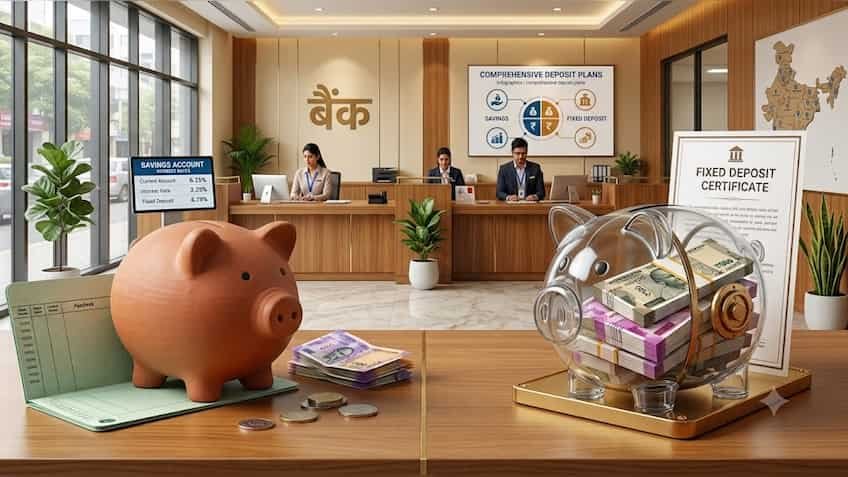
Whenever everyone from middle class families to employed youth across the country gets lump sum capital, the first thought that comes to their mind is to keep the money safe in the bank. When the hard-earned money of common citizens of cities like Lucknow, Kanpur, Delhi, Jaipur or Patna reaches the bank accounts, most of the people just consider it safe and leave it. Usually this amount remains in the savings account or some conscious citizens convert it into fixed deposit. In the era of financial literacy, it has become very important to know that if you have exactly ₹ 1 lakh in cash, what will be the benefit of leaving it in a savings account and how much net profit will be given by the bank if an FD of the same amount is made. If you do not choose the right option amid the fluctuations in interest rates and inflation, your savings start losing real value over time. Complete mathematics and interest calculation of keeping ₹ 1 lakh in a savings account. The biggest feature of a savings account is that your money remains in a liquid state at every moment. You can make purchases or withdraw cash whenever you want through UPI, debit card or net banking. Major public and private commercial banks like State Bank of India, Punjab National Bank, Bank of Baroda, HDFC Bank and ICICI Bank generally offer simple interest at the rate of 2.50 percent to 3.00 percent per annum on general savings accounts. Some small finance banks also offer interest ranging from 3.50 to 4.00 percent to attract new customers. Interest in savings account is calculated on the basis of daily closing balance and is credited to the account at the end of each quarter. If you maintain an amount of ₹ 1 lakh in your savings account without any disturbance for a whole year, then at an average rate of 2.70 percent, you will get an interest of approximately ₹ 2,727 in a year. If the bank is offering a rate of 3.00 per cent, the total interest earned over the entire twelve months comes to around ₹3,034. This simply means that by leaving ₹1 lakh in a savings account, you hardly get an extra ₹220 to ₹250 per month, which proves to be negligible in comparison to today’s inflation rate. Investing ₹ 1 Lakh in Fixed Deposit: The Real Magic of Compounding If you deposit the same ₹ 1 Lakh in the bank as a fixed deposit i.e. FD for a fixed period, then the interest equation changes completely. In FD, the money gets contracted for a fixed time limit and instead of simple interest, the rule of quarterly compounding applies. This means that the interest earned every three months is added to your principal balance and interest is calculated on the increased balance in the next quarter. In the current banking scenario, major banks of the country are offering 6.50 percent to 7.10 percent annual interest to general citizens on FDs of 1 year to 5 years, while senior citizens get the benefit of 0.50 percent additional interest in each slab. If you make a 1 year FD of ₹1 lakh at the rate of 6.50 percent, then on maturity you get ₹1,06,660, of which the net interest is ₹6,660. Whereas if this rate is 7.00 percent, then after adding interest of ₹ 7,186 in one year, the total amount becomes ₹ 1,07,186. At the rate of 7.10 percent for a period of 3 years, this same ₹ 1 lakh increases to ₹ 1,23,450, of which the interest share remains ₹ 23,450. If you deposit money at 7.00 per cent per annum for a long tenure of 5 years, the maturity amount becomes ₹1,41,478, i.e. you get a net guaranteed profit of ₹41,478 without any risk. Some small finance banks are giving returns up to 8.00 percent on FDs of 1 to 3 years, which increases this earning even more. Solution to emergency withdrawals, pre-mature penalties and auto-sweeps When choosing between a savings account and a fixed deposit, just looking at the interest rate is not enough, it is also important to keep in mind the quick availability of money. Money can be withdrawn from the savings account at any time and there is no fine or penalty on it. On the contrary, if you break the FD before the stipulated time or get pre-mature closure done, then most of the banks deduct 0.50 percent to 1.00 percent from the applicable interest rate as penalty. To deal with this problem, the facility of ‘auto-sweep’ i.e. sweep-in deposit is becoming very popular in modern banking. Under this system, the account holder sets a minimum limit in his savings account such as ₹ 25,000. Above this, as soon as the additional balance reaches ₹ 1 lakh, the additional amount is automatically converted into FD and higher FD interest starts earning on it. Whenever you need to withdraw money from ATM or make payment through UPI, the system automatically breaks the same amount from the FD and brings it to the savings account and the FD interest continues to accrue on the remaining amount without any penalty. Income Tax and TDS rules: In which option will tax be deducted? The interest income earned in banks is not completely tax-free, but strict rules of Income Tax Act apply to it. Under Section 80TTA of the Income Tax Act, interest up to ₹ 10,000 received from all savings accounts within a financial year is completely tax-free and no tax has to be paid on it. This exemption under Section 80TTB is valid up to ₹50,000 for senior citizens above 60 years of age. On the other hand, interest from fixed deposits comes under the fully taxable income category and is added to your annual income. If the total interest earned from all your FD accounts in a financial year exceeds ₹40,000 (₹50,000 for senior citizens), the bank deducts 10 percent TDS as per rules. If you do not have updated PAN card then this TDS can be deducted up to 20 percent. However, if your total annual income is within the tax exemption limit, you can prevent TDS from being deducted by submitting Form 15G or Form 15H to the bank. What should be the right decision according to your needs? Financial planners and banking experts clearly believe that leaving money lying in the savings account without any purpose is a deal of financial loss. If the amount of ₹1 lakh you have is part of an emergency fund that may be needed anytime in the next month or two, then it is wisest to keep it in a savings account or link it to the auto-sweep facility. But if this amount is not going to be used for any emergency expenditure for the next 1 year, 3 years or 5 years, then it should be deposited in the fixed deposit scheme of a reputed bank without any delay, so that you can get safe and guaranteed returns of double to three times as compared to savings account.